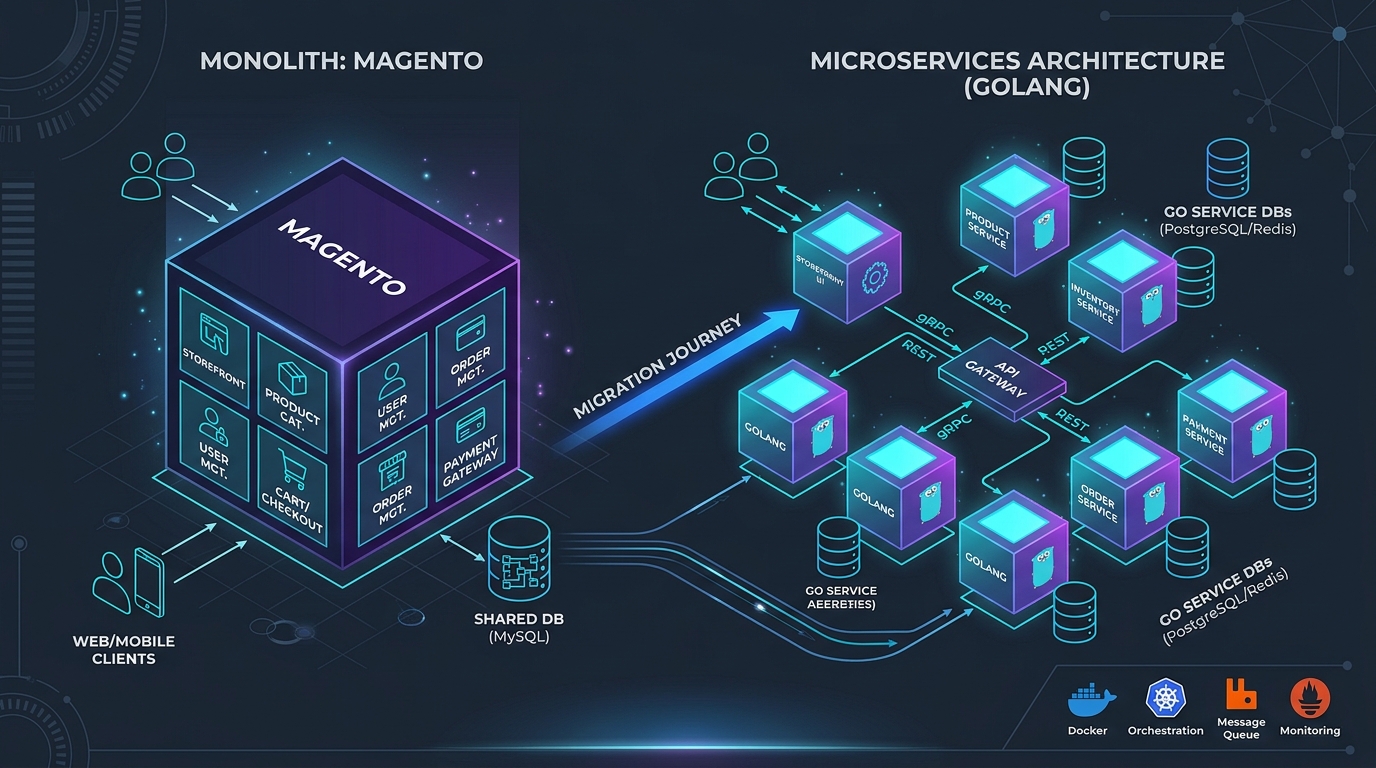
Prerequisite: Read Part 1 — Is Magento Worth It in 2026? for context on platform roadmap and EOL deadlines.
Migrating Magento to Microservices: When & Why
Answer-first: Migrating Magento to microservices becomes an urgent engineering imperative when monolithic MySQL lock contention on sales_flat_quote and catalog_product_entity causes checkout timeouts during high-concurrency traffic spikes (>1,500 requests/sec). Implementing an event-driven Go microservices architecture with distributed Saga orchestration decouples read-heavy catalog queries from write-heavy order processing, guaranteeing sub-50ms P99 latency bounds, horizontal Kubernetes pod auto-scaling, and independent team deployment cycles.
Every successful e-commerce business that started on Magento eventually hits the same structural wall: the platform that enabled rapid initial growth becomes the very bottleneck preventing further scale.
The symptoms are universal: database CPU spikes to 100% during marketing campaigns, background indexers lag by hours, and deploying a minor frontend modification requires a high-risk full-site deployment window.
1. The Monolithic Bottleneck Topology
In a standard Magento deployment, all operational domains compete for locks on a single relational MySQL instance:
graph TD
    subgraph Client_Traffic ["Unified Client Ingress"]
        Shoppers["Shoppers Browsing Catalog"]
        Buyers["Buyers Placing Orders (Flash Sale)"]
        AdminUsers["Merchandisers Updating Prices & Inventory"]
        BackgroundCron["Scheduled Re-indexers & Sync Cron Jobs"]
    end

    Shoppers --> PHP_FPM["Shared PHP-FPM Monolith Cluster"]
    Buyers --> PHP_FPM
    AdminUsers --> PHP_FPM
    BackgroundCron --> PHP_FPM

    PHP_FPM --> MySQL_Single["Single MySQL Master Instance"]

    subgraph Monolith_Contention ["Database Lock Contention"]
        MySQL_Single --> Lock1["Row Locks: sales_flat_quote & quote_item"]
        MySQL_Single --> Lock2["Table Locks: catalog_product_index_price"]
        MySQL_Single --> Lock3["Deadlock on sequence_order_* tables"]
    end

    Lock1 --> Outage["504 Gateway Timeouts & Lost Revenue"]
    Lock2 --> Outage
    Lock3 --> Outage
The Five Structural Walls of Magento Monoliths
- The EAV Database Locking Wall: In Magento, modifying product inventory or updating a customer address causes cascading row and metadata locks across multiple tables, stalling parallel read threads.
- The Indexer Latency Wall: Catalog price and stock indexers take 45–90 minutes on catalogs exceeding 100,000 SKUs, resulting in stale prices or ghost stock being sold.
- The Deployment Risk Wall: Because all code lives in one monolith, a bug introduced in an obscure admin shipping extension can crash the public customer checkout flow.
- The Resource Inefficiency Wall: Scaling a PHP monolith requires spinning up full 8-core/32GB RAM compute instances that load the entire Magento core framework for every simple request.
- The Talent Specialization Wall: Senior Magento PHP developers are increasingly rare and expensive, while modern cloud-native engineers prefer working in Golang, Rust, or TypeScript.
2. Distributed Saga Orchestration for Resilient Checkout
When decomposing a monolithic e-commerce application, distributed transactions cannot rely on two-phase commit (2PC) protocols due to network latency. Instead, production Go microservices implement the Orchestrated Saga Pattern:
sequenceDiagram
    autonumber
    actor Customer
    participant Gateway as "API Gateway (Envoy)"
    participant Saga as "Order Saga Orchestrator (Go)"
    participant Inventory as "Inventory Service (Redis Lock)"
    participant Payment as "Payment Service (Stripe / VNPay)"
    participant Order as "Order Service (PostgreSQL)"

    Customer->>Gateway: POST /v1/checkout/submit
    Gateway->>Saga: StartCreateOrderSaga(CartID)

    Saga->>Inventory: ReserveStock(SKU, Qty)
    alt Stock Available
        Inventory-->>Saga: Stock Reserved OK
        Saga->>Payment: AuthorizePayment(Amount, Token)
        alt Payment Succeeded
            Payment-->>Saga: Payment Authorized OK
            Saga->>Order: CreateConfirmedOrder(Payload)
            Order-->>Saga: Order Created #ORD-9401
            Saga-->>Gateway: Checkout Completed
            Gateway-->>Customer: 200 OK (Order Confirmed)
        else Payment Failed
            Payment-->>Saga: Insufficient Funds
            Saga->>Inventory: CompensateReleaseStock(SKU, Qty)
            Inventory-->>Saga: Stock Released
            Saga-->>Gateway: Payment Failed Error
            Gateway-->>Customer: 402 Payment Required
        end
    else Out of Stock
        Inventory-->>Saga: Stock Insufficient
        Saga-->>Gateway: Inventory Error
        Gateway-->>Customer: 409 Conflict (Out of Stock)
    end
3. Production Go Code: Distributed Saga Coordinator
The following Go implementation coordinates order creation across independent microservices with compensating transactions upon payment failure:
package main

import (
	"context"
	"errors"
	"fmt"
	"time"
)

type OrderSagaCoordinator struct {
	inventoryClient InventoryClient
	paymentClient   PaymentClient
	orderClient     OrderClient
}

type InventoryClient interface {
	Reserve(ctx context.Context, orderID string, sku string, qty int) error
	Release(ctx context.Context, orderID string, sku string, qty int) error
}

type PaymentClient interface {
	Authorize(ctx context.Context, orderID string, amountCents int64) (string, error)
}

type OrderClient interface {
	Save(ctx context.Context, orderID string, sku string, qty int, paymentRef string) error
}

func (s *OrderSagaCoordinator) ExecuteOrderSaga(ctx context.Context, orderID, sku string, qty int, amountCents int64) error {
	// Step 1: Reserve Inventory
	if err := s.inventoryClient.Reserve(ctx, orderID, sku, qty); err != nil {
		return fmt.Errorf("inventory reservation failed: %w", err)
	}

	// Step 2: Authorize Payment
	paymentRef, err := s.paymentClient.Authorize(ctx, orderID, amountCents)
	if err != nil {
		// Compensating Transaction: Release reserved stock
		compCtx, cancel := context.WithTimeout(context.Background(), 5*time.Second)
		defer cancel()
		_ = s.inventoryClient.Release(compCtx, orderID, sku, qty)
		return fmt.Errorf("payment authorization failed, stock compensated: %w", err)
	}

	// Step 3: Persist Confirmed Order
	if err := s.orderClient.Save(ctx, orderID, sku, qty, paymentRef); err != nil {
		return fmt.Errorf("order persistence failed: %w", err)
	}

	return nil
}
4. Comparative Matrix: Monolith vs Distributed Microservices
| Attribute | Magento 2 PHP Monolith | Distributed Go Microservices |
|---|---|---|
| Peak Throughput per CPU Core | ~85 requests/second | 8,500+ requests/second |
| Database Architecture | Single MySQL Shared DB (EAV) | Database-per-service (PostgreSQL, Redis, LanceDB) |
| Blast Radius of Failure | Global (entire site crashes) | Isolated to specific domain container |
| P99 API Latency | 1,200ms - 3,500ms | 25ms - 65ms |
| Deployment Cadence | Bi-weekly high-risk releases | Multiple independent daily deployments |
| Memory Footprint | ~180MB RAM per PHP-FPM worker | ~15MB RAM per Go service binary |
❓ Frequently Asked Questions (FAQ)
Why does Magento experience severe database deadlocks during flash sales?
cataloginventory_stock_item, quote, and sales_order tables. Because InnoDB enforces strict lock sequences on foreign keys and auto-increment tables, cross-transaction lock contention frequently escalates into deadlocks that abort active checkouts.How does a Go microservices architecture handle distributed data consistency without two-phase commit (2PC)?
Can we migrate only the checkout and cart services to Go while leaving the rest in Magento?
/api/cart/* and /api/checkout/* to high-speed Go microservices, while catalog viewing and admin operations continue running in Magento until later phases.🔗 Next Step: Proceed to Part 3 — Composable E-Commerce Migration: Overcoming Tech Debt.