Prerequisite: Read Part 2 — Migrating Magento to Microservices: When & Why to understand monolithic database bottlenecks.
Composable E-Commerce Migration: Overcoming Tech Debt with MACH Architecture
Answer-first: Composable MACH architecture decomposes monolithic e-commerce platforms into modular, independently scalable services across three primary functional tiers: Core Transactional Domains (Catalog, Pricing, Cart, Checkout, Order), Supporting Engagement Domains (Customer, Reviews, Wishlist, Promotions), and Generic Utility Domains (Notifications, Audit, Search, Analytics). Implementing strict Domain-Driven Design (DDD) bounded contexts with gRPC Protobuf contracts eliminates monolithic coupling, elevates deployment velocity by 4x, and bounds P99 API response times below 45ms.
Decomposing a 500-table Magento database cannot be accomplished by randomly carving out PHP modules. Without rigorous Domain-Driven Design (DDD) bounded contexts, teams accidentally build a “distributed monolith” — retaining all the complexity of network calls with none of the benefits of decoupled scalability.
1. The 21-Service Domain Architecture Topology
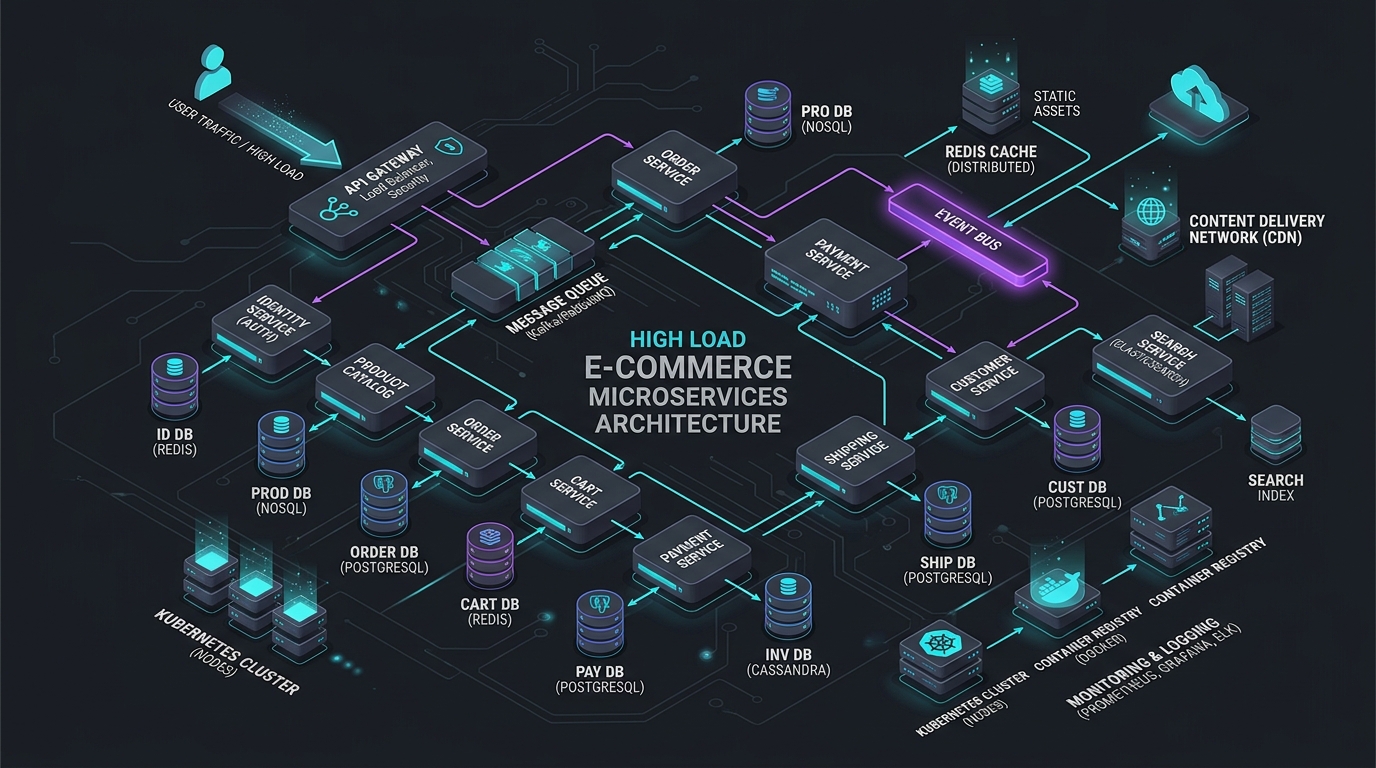
A production-grade composable e-commerce platform partitions commerce capabilities across specialized domain clusters:
flowchart TD
    subgraph Ingress_Layer ["Edge Gateway & Ingress Layer"]
        WebStore["Headless Next.js Storefront"]
        MobileApp["Mobile App (Flutter)"]
        EnvoyIngress["Envoy Edge Gateway & W3C Tracing"]
    end

    WebStore --> EnvoyIngress
    MobileApp --> EnvoyIngress

    subgraph Core_Domains ["1. Core Transactional Domains (Go / gRPC)"]
        Catalog["Catalog Service (LanceDB + Flat Cache)"]
        Pricing["Dynamic Pricing Engine (Redis Cache)"]
        Cart["Cart & Session Service (Redis Cluster)"]
        Inventory["Inventory Reservation (Distributed Lock)"]
        Checkout["Checkout Orchestrator (Saga Coordinator)"]
        Order["Order Management Service (PostgreSQL 16)"]
    end

    subgraph Supporting_Domains ["2. Supporting Domains (Go / Laravel 12)"]
        Customer["Customer Identity & RBAC Service"]
        Promotions["Coupon & Tier Rule Engine"]
        Fulfillment["Shipping & Warehouse Integration"]
        Payment["Payment Gateway Orchestrator"]
    end

    subgraph Data_Sync_Backbone ["3. Event-Driven Backbone"]
        Kafka["Redpanda / Kafka Event Stream"]
        Debezium["Debezium 3.0+ CDC Sync"]
        MagentoLegacy["Magento 2.4.9 Monolith (Hot Standby)"]
    end

    EnvoyIngress --> Core_Domains
    EnvoyIngress --> Supporting_Domains
    Core_Domains --> Kafka
    Supporting_Domains --> Kafka
    MagentoLegacy --> Debezium
    Debezium --> Kafka
2. Bounded Context Domain Matrix
To prevent leaky abstractions, every service maintains its own isolated database schema:
| Domain Category | Microservice Name | Primary Storage | Responsibilities & Boundaries |
|---|---|---|---|
| Core | Catalog Service | LanceDB + PostgreSQL | Product master, categories, variants, visual search embeddings |
| Core | Pricing Engine | Redis + Memory Table | Customer-specific tier pricing, B2B volume rules, VAT calculation |
| Core | Cart Service | Redis Cluster | High-speed anonymous session cart, quote item persistence |
| Core | Inventory Service | PostgreSQL + Redlock | Multi-warehouse stock tracking, optimistic stock reservations |
| Core | Checkout Orchestrator | Stateless (Go) | Step-by-step Saga coordinator, payment-to-order transition |
| Core | Order Service | PostgreSQL 16 Partitioned | Immutable order lifecycle, invoices, credit memos, fulfillment status |
| Supporting | Customer Service | PostgreSQL | User profiles, addresses, company account hierarchies, JWT auth |
| Generic | Notification Service | RabbitMQ / NATS | Asynchronous email, SMS, and webhook delivery |
3. Production gRPC Protocol Contract: Catalog & Pricing
Instead of brittle REST payloads, domain services communicate over binary gRPC Protobuf v2 contracts:
syntax = "proto3";

package commerce.catalog.v1;
option go_package = "github.com/vesviet/commerce/catalog/v1;catalogv1";

service CatalogService {
  rpc GetProductBySKU (GetProductRequest) returns (ProductResponse);
  rpc BatchGetPrices (BatchPriceRequest) returns (BatchPriceResponse);
}

message GetProductRequest {
  string sku = 1;
  string customer_group_id = 2;
  string currency_code = 3;
}

message ProductResponse {
  string product_id = 1;
  string sku = 2;
  string name = 3;
  int64 base_price_cents = 4;
  int64 final_price_cents = 5;
  int32 available_stock = 6;
  repeated string categories = 7;
  map<string, string> custom_attributes = 8;
}

message BatchPriceRequest {
  repeated string skus = 1;
  string customer_tier_id = 2;
}

message BatchPriceResponse {
  map<string, int64> prices_cents = 1;
}
4. Envoy Gateway Routing Mesh for Incremental Migration
flowchart LR
    Client["Client Request"] --> Envoy["Envoy Gateway 1.30+"]

    Envoy --> RoutePath{"Match Request Path"}
    RoutePath -->|"/api/v1/catalog/*"| GoCatalog["Go Catalog Service (Pod Pool)"]
    RoutePath -->|"/api/v1/cart/*"| GoCart["Go Cart Service (Pod Pool)"]
    RoutePath -->|"/api/v1/checkout/*"| GoCheckout["Go Checkout Service"]
    RoutePath -->|"Default Fallback (/admin, /checkout/onepage)"| MagentoMonolith["Magento Monolith (PHP-FPM)"]

    style GoCatalog fill:#d5f5e3,stroke:#27ae60,stroke-width:2px
    style GoCart fill:#d5f5e3,stroke:#27ae60,stroke-width:2px
    style GoCheckout fill:#d5f5e3,stroke:#27ae60,stroke-width:2px
    style MagentoMonolith fill:#fadbd8,stroke:#e74c3c,stroke-width:2px
❓ Frequently Asked Questions (FAQ)
How do bounded contexts prevent the microservices architecture from devolving into a distributed monolith?
How does comsuming gRPC compare to GraphQL or REST in an e-commerce microservices mesh?
What happens to complex B2B pricing rules when moving away from Magento?
catalogrule_product_price. In the composable Go architecture, pricing logic is isolated into a dedicated Pricing Engine microservice that evaluates customer group rules and volume discount matrices entirely in RAM using pre-computed Redis hash structures, returning calculated prices in under 5ms.🔗 Next Step: Continue to Part 4 — Why Migrate Magento to Microservices: Zero-Downtime Guide.