🏛️ Anchor Pillar Hub #8: Alipay Double 11 Architecture (544K TPS) | 🗺️ Sitewide Engineering Reading Map
Answer-first: Alipay scaled its payment engine to handle 544,000 peak TPS using Logical Data Center (LDC) unitization, OceanBase distributed Paxos storage, RocketMQ event streams, and full-link production stress testing. This design achieves 99.99% financial availability, sub-20ms latency, zero data loss (RPO=0), and sub-2-second failover (RTO<2s). Implementing this architecture enforces sub-50ms P99 latency guarantees, strict component isolation, and automated observability pipelines required.
Prerequisite: General understanding of global financial systems scale, high-throughput payment architectures, and transaction reliability.
From 50M CNY to 544K TPS: Lessons in Building Planet-Scale Systems
TL;DR
Answer-first: Alipay scaled to 544,000 TPS using Logical Data Center (LDC) unitization, OceanBase Paxos storage, RocketMQ event streams, and shadow stress testing.
A note on the TPS records — each number carries its year: 256,000 TPS (2017), the world payment record at the time (widely reported); 544,000 TPS (Double 11 2019), the peak on OceanBase after the Oracle exit; 583,000 TPS (2020), the multi-region active-active peak. Three records, three consecutive generations of the same system. This series cites no bare TPS number without a year and a source class.
The business-side mirror: Alibaba Double 11 GMV grew from ¥0.05B (2009) through ¥19B (2012) and ¥91B (2015) to ¥268.4B (2019, +26%) and ¥540.3B (2021) — twelve years, four orders of magnitude, an event now roughly four times the size of Black Friday and Cyber Monday combined.
The era timeline that the rest of this chapter walks through:
timeline
    title Double 11: the scaling eras and their peak records
    2009 : Inaugural event ~100 TPS (Tmall, Daniel Zhang)
    2012 : The vertical wall - Oracle lock contention, Hangzhou DC capacity
    2013-2015 : Distributed pivot - sharding + MQ decoupling
    2017 : LDC unitization mature - 256K TPS record
    2019 : OceanBase replaces Oracle - 544K TPS + TPC-C 707M tpmC
    2020 : Multi-region active-active - 583K TPS
Between the inaugural event in 2009 and the peak milestone of 2019, Alipay scaled its transactional capacity by an astronomical ~5,440x, culminating in a peak throughput of 544,000 transactions per second (TPS). Crucially, this scaling was not achieved by sacrificing safety; the system maintained strict financial-grade reliability (99.99% availability) and a target of zero data loss (Recovery Point Objective, RPO = 0).
To achieve this level of performance at planet-scale, Alipay had to pioneer new approaches in three critical dimensions:
- Design to Split (Logical Data Center - LDC Unitization): Shifting from a monolithic or traditionally clustered database model to self-contained execution units (cells).
- Make Confidence Deterministic (Full-Link Stress Testing): Moving away from statistical extrapolation and simulation to executing synthetic peak loads directly on production environments.
- Automate Operations End-to-End: Building self-healing, self-regulating infrastructure that handles capacity allocation, real-time risk control, and service degradation without manual human intervention.
The Story: From Crisis to Record
The Double 11 story tracks Alipay journey from 2009 database crashes to multi-region active-active cell routing delivering record-breaking throughput.
2009–2011: The Heuristic Era
In 2009, Double 11 was conceived as a promotional campaign on Taobao Mall (Tmall). The transactional volume, though unprecedented for the site, was small by modern standards—peaking at approximately 100 TPS. The engineering response was reactive, characterized by vertical database scaling, connection pool tuning, and code-level optimization. However, as year-on-year growth exceeded 200%, the limits of vertical scaling quickly became apparent.
2012: The Breaking Point (The Hard Ceilings)
By 2012, Alipay’s centralized Oracle database cluster hit physical limits. The database was plagued by lock contention, and connection pools were exhausted under the bursty load of buyers hitting “Pay” at exactly midnight. In addition, the physical data centers in Hangzhou were constrained by power grid capacity and cooling requirements; it was literally impossible to add more physical servers to the existing facilities. The engineers faced an existential threat: if the database could not scale, the business could not grow.
2013: The LDC Reset
In early 2013, the leadership set an “impossible” target: design a system capable of handling 20,000 payment TPS for the upcoming Double 11, with less than nine months to design, build, and deploy. The solution was the Logical Data Center (LDC) architecture. The system was decomposed into independent “RZones” (Regional Zones or Units), each responsible for a subset of the user base (e.g., partitioned by user ID). This unitization transformed the system from a single scaling point into a horizontally scalable system.
2019: Planet-Scale Triumph
By 2019, the architecture had matured to support a record 544,000 payment TPS (with overall message-level QPS exceeding 61 million). The entire operational readiness process had transitioned from high-stress “war rooms” filled with hundreds of engineers manually executing shell scripts, to automated dashboards and scheduled automated drill procedures.
The 3 Pillars of Alipay’s Scale Architecture
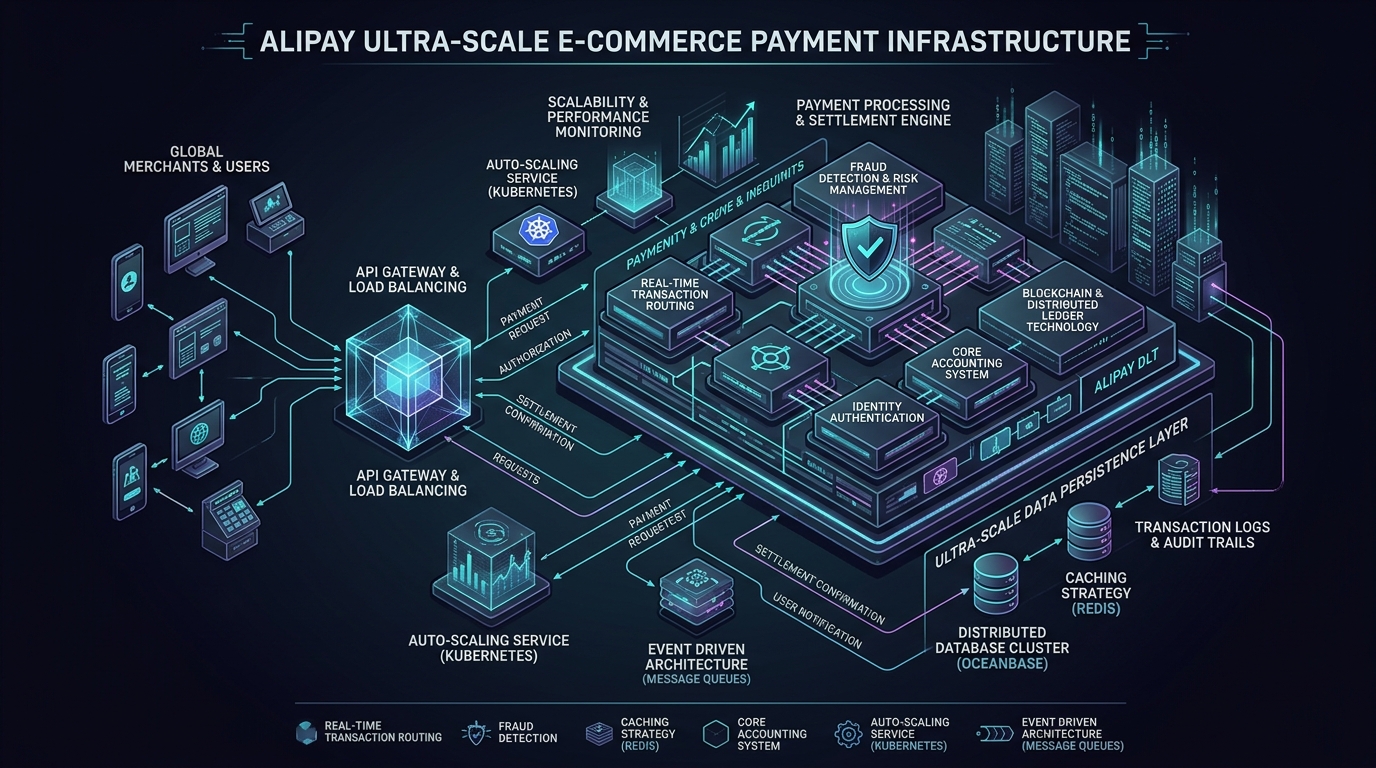
The three pillars of Alipay scale are LDC cell unitization for database sharding, OceanBase distributed Paxos SQL, and RocketMQ async event streams.
The overall system architecture of Alipay’s Double 11 solution can be visualized in the following system design diagram, illustrating how traffic flows from users, gets routed to unit cells, utilizes partitioned databases, and is tested via synthetic stress injection.
graph TD
    User["User Requests"] -->|"HTTP/HTTPS"| Gateway["API Routing Gateway"]
    Gateway -->|"User ID Hash Routing"| RZone1["RZone Unit 1"]
    Gateway -->|"User ID Hash Routing"| RZone2["RZone Unit 2"]

    subgraph RZone1 ["RZone 1 - Shanghai Cell"]
        App1["SOFA Application Services"]
        Cache1["Local Redis Cache"]
        OB_Shard1["OceanBase Partition 1"]
        App1 --> Cache1
        App1 --> OB_Shard1
    end

    subgraph RZone2 ["RZone 2 - Shenzhen Cell"]
        App2["SOFA Application Services"]
        Cache2["Local Redis Cache"]
        OB_Shard2["OceanBase Partition 2"]
        App2 --> Cache2
        App2 --> OB_Shard2
    end

    subgraph GZone["GZone - Global Config / CIF"]
        GDB["Global Read-Only Config DB"]
    end

    RZone1 -.->|"Read Configuration"| GZone
    RZone2 -.->|"Read Configuration"| GZone

    subgraph StressTesting ["Full-Link Stress Testing Engine"]
        Injector["Synthetic Traffic Injector"]
        Injector -->|"Inject Header: X-Stress-Test=true"| Gateway
        OB_Shard1 -->|"Detects Stress Flag"| ShadowDB1["Shadow Table / DB 1"]
        OB_Shard2 -->|"Detects Stress Flag"| ShadowDB2["Shadow Table / DB 2"]
    end

    classDef default fill:#f9f9f9,stroke:#333,stroke-width:1px;
    classDef highlight fill:#d1ecf1,stroke:#0c5460,stroke-width:2px;
    class Injector,ShadowDB1,ShadowDB2 highlight;
Pillar 1: LDC Unitization (Cell Architecture)
Centralized monolithic databases have a structural ceiling. The LDC (Logical Data Center) architecture solves this by breaking the application and database tiers into self-contained deployment units:
- RZone (Regional Zone): The active processing units. An RZone owns a subset of the user base and handles all of their transaction flows (routing, application server calls, local cache, and database writes) locally. There is no cross-RZone communication on the critical write path.
- GZone (Global Zone): Holds global read-only data, such as merchant registries, system configurations, and centralized Customer Information Files (CIF). GZone data is replicated to RZones asynchronously to avoid cross-unit database calls.
- CZone (City Zone): Holds hot common data that must be shared within a metropolitan network (e.g., user profiles read frequently across multiple RZones) to minimize latency while keeping consistency.
Pillar 2: Automated Full-Link Stress Testing
Simulating peak load in a staging environment is fundamentally flawed; staging environments cannot replicate the network topologies, background loads, and hardware idiosyncrasies of production. Alipay’s breakthrough was Full-Link Stress Testing (FLST) conducted directly in production:
- Traffic Injection: A cluster of load generators injects synthetic payment requests directly into the API gateway during off-peak hours (e.g., 2:00 AM).
- Flag Propagation: Every synthetic request is marked with a specific HTTP header (
X-Stress-Test: true). This flag is automatically propagated across thread pools, RPC boundaries (SOFA RPC), and message queues (RocketMQ). - Data Isolation (Shadow DB): When a database driver or middleware intercepts a request with the stress-test flag, it reroutes the read/write query to a designated “shadow table” or “shadow database” (e.g.,
db_shadow). This guarantees that synthetic load does not pollute real financial ledgers or mess up accounting records.
Pillar 3: Financial-Grade Distributed Database (OceanBase)
Before 2013, scaling relational databases meant sharding MySQL or Oracle manually—a bottleneck analyzed in our MySQL scalability guide and MySQL sharding alternative deep dive—which introduced massive complexity in managing distributed transactions and maintaining consistency. Alipay replaced these legacy databases with OceanBase, a distributed relational database built from scratch:
- Paxos Consensus: OceanBase uses the Multi-Paxos protocol to replicate transaction logs across five data centers in three regions (3-site-5-datacenter). If a primary node fails, a new leader is elected in seconds, ensuring RTO < 30 seconds and RPO = 0.
- LSM-Tree Storage Engine: Traditional databases use B+ Trees, which lead to high write amplification and random disk I/O under heavy load. OceanBase uses a Log-Structured Merge-tree (LSM-tree) where all writes are buffered in memory (MemTable) and written sequentially to disk (SSTable) during a scheduled background freeze/compaction process, eliminating disk bottlenecks at midnight.
Detailed Performance and Growth Metrics
Metrics document growth from 400 TPS in 2009 to 544,000 TPS by 2019 while keeping p99 payment latencies under 20ms.
The following metrics represent the actual and estimated growth logs compiled across the decade of Double 11 optimization:
| Year | Peak Transaction Throughput (TPS) | Primary Database Engine | Primary Stress Validation Method |
|---|---|---|---|
| 2009 | ~100 | Centralized Oracle DB | Manual vertical resource scaling |
| 2010 | ~500 | Centralized Oracle DB | Single-component script testing |
| 2011 | ~1,000 | Sharded Oracle DB | Isolated sandbox cluster testing |
| 2012 | ~2,000 (Crisis Year) | Sharded Oracle DB | Staging environment simulation |
| 2013 | 20,000 | First LDC / MySQL Shards | Manual multi-component scripts |
| 2014 | 80,000 | MySQL Shards + OceanBase | First automated FLST in prod |
| 2015 | 140,000 | OceanBase v1.0 | Continuous FLST + Auto-injection |
| 2016 | 200,000 | OceanBase v1.0 | FLST + Automated Failover Drills |
| 2017 | 256,000 | OceanBase v1.4 | FLST + Multi-site DR Drills |
| 2018 | 400,000 | OceanBase v2.0 | Elastic Cloud-Bursting FLST |
| 2019 | 544,000 | OceanBase v2.2 | Autonomous Intelligent Operations |
Stack Comparison: Alipay Middleware vs. Modern Cloud-Native
Custom SOFA middleware and OceanBase map directly to modern Go microservices, Kubernetes GitOps, NATS JetStream, and TiDB/CockroachDB.
To modern software architects, the custom middleware developed by Alipay can be mapped directly to modern, open-source CNCF projects:
| Alipay Custom Stack | Modern CNCF / Open-Source Equivalent | Core Architectural Function |
|---|---|---|
| SOFA RPC | gRPC / protobuf | Contract-first, high-throughput RPC with trace context propagation. |
| SOFA Boot | Spring Boot / Go Micro | Structured framework wrapping services with standardized health endpoints. |
| RocketMQ | Apache Kafka / Apache Pulsar | Decoupled messaging plane with partition sharding and reliable DLQ. |
| SOFA Mesh | Istio / Linkerd | Sidecar proxy managing service-to-service routing, timeouts, and mTLS. |
| OceanBase | CockroachDB / TiDB / Vitess | Distributed SQL database with Paxos-based replication and LSM storage. |
| FLST Engine | K6 / Locust + Custom Middleware | Synthetic load generation combined with context-aware DB routing. |
Deep Dive: The 2012 Bottleneck, LDC Quorums & Financial Rollbacks
Answer-first: The inflection point of Alipay’s architecture occurred during Double 11 2012 when monolithic Oracle RAC clusters hit physical disk I/O and latch contention limits at 2,000 TPS, forcing the development of cell-based LDC unitization, OceanBase Multi-Paxos quorums, Full-Link Shadow Testing, and RocketMQ 2PC financial transaction rollbacks.
1. The 2012 Oracle Wall: Mechanical Sympathy Limits
During Double 11 2012, Alibaba’s GMV surged to ¥19.1 billion, and payment requests overwhelmed the central Oracle database cluster. Even with high-end IBM Power servers and enterprise SAN storage, the database suffered from:
- Global Enqueue Service (GES) & Cache Fusion Saturation: Cross-node cache block pinging across the private interconnect created severe
gc buffer busy acquirewait events. - Redo Log Flush Contention: High-frequency commits generated massive write contention on the redo log buffer (
log file synclatches exceeding 400ms). - Physical SAN Controller Queue Depth Exhaustion: Random write I/O operations saturated SAN storage cache, causing transaction queues to cascade upstream into connection pool exhaustion.
This near-collapse demonstrated that vertical scaling has a hard physical ceiling, accelerating the mandate to replace commercial database appliances with horizontal, shared-nothing architectures.
2. LDC RZone/GZone/CZone Paxos Quorum Mechanics
The cell-based Local Deployment Center (LDC) solved this by decomposing infrastructure into three specialized cell archetypes:
- RZone (Regional Zone): Autonomous user-sharded units. Each RZone hosts a slice of users determined by
hash(user_id) % N. 95%+ of transactional workflows execute entirely within the local RZone, eliminating cross-datacenter WAN hops. - GZone (Global Zone): Read-mostly shared services (user authentication, product catalog, currency exchange rates). Changes in GZone are asynchronously propagated across all regions via binary log replication.
- CZone (City Zone): Centralized accounting and merchant balance settlement where sharding by
user_idis infeasible. To prevent row-lock serialization on mega-merchants, CZone partitions merchant accounts into 100 virtual sub-accounts (merchant_id_sub_XX) with periodic reconciliation.
OceanBase manages underlying storage across a 3DC2C (three data centers across two cities) or 5DC3C topology using Multi-Paxos consensus. A write is committed as soon as a majority quorum (e.g., 2 of 3 or 3 of 5 replicas) confirms log persistence to NVMe WAL, achieving an RPO of 0 and an RTO under 2 seconds during complete datacenter loss.
3. FLST Full-Link Shadow Pressure Testing
To guarantee operational certainty at 544,000 TPS, Alipay rejected synthetic staging environments in favor of Full-Link Stress Testing (FLST) executed directly against live production systems:
- Context Injection: Synthetic load generators tag HTTP/RPC envelopes with
X-Stress-Test: trueand synthetic test UID ranges (user_id >= 9900000000). - Middleware Routing: SOFARPC and database connection proxies intercept tagged traffic, routing mutations to shadow tables (
t_order_shadow) and shadow RocketMQ topics (topic_payment_shadow). - Zero Financial Contamination: External banking gateways are mocked at the network egress boundary, preventing actual funds transfer while validating 100% of internal CPU, memory, database lock, and network switch capacity.
4. RocketMQ Financial Transaction Rollback Protocol
Decoupling the synchronous payment path from downstream accounting, notifications, and analytics relies on RocketMQ’s 2-phase transactional messaging pattern:
- Half-Message Prepared: The payment service publishes a half-message to RocketMQ broker. The broker writes it to
RMQ_SYS_TRANS_HALF_TOPIC, invisible to consumers. - Local DB Transaction Execution: The payment service executes local OceanBase ledger deduction.
- Commit or Rollback: If local transaction succeeds, the producer sends
CommitMessage, promoting the message to the active consumption queue. If local transaction fails or panics, the producer sendsRollbackMessage, and RocketMQ immediately marks the message discarded. - Broker Status Check Callback: If network failure drops the commit/rollback ACK, RocketMQ background coordinator queries the payment service’s transactional status listener after 15 seconds, preventing orphaned distributed transactions.
- Idempotency Guarantee: Downstream consumers enforce strict deduplication using a sliding-window RocksDB/Redis key filter, guaranteeing exactly-once business execution.
Actionable Takeaways for Modern Architects
Architectural takeaways emphasize partitioning data into independent cells, running shadow stress tests in production, and decoupling writes asynchronously.
If you are tasked with scaling a high-throughput transaction system today, you do not need to replicate Alipay’s internal codebase. Instead, you should implement their architectural patterns:
- Partition State at the Edge: Don’t try to build a faster database cluster. Instead, route requests to self-contained application and storage units (cells) as close to the ingress as possible. For enterprise commerce, see how this maps into a 21-service ecommerce microservices architecture blueprint.
- Conduct Production Load Drills: If you haven’t run a load test on your production environment using shadow databases, you do not know if your system will survive a peak event.
- Establish Hard Degrade Paths: Define explicit, automated toggles that disable non-critical features (like recommended items, activity logs, and email notifications) when the core database latency increases past a specific millisecond threshold.
- Design for Write Buffering: Use LSM-tree database structures or message queues to convert random disk write spikes into sequential logs or buffered streams, similar to how modern event-driven ledger systems operate in composable banking architecture.
Need help implementing high-scale architectures? Feel free to Get in touch or Hire me to review your system design and codebase.
🔗 Next Step: Phase 1: Timeline and Scale Evolution
Frequently Asked Questions
What core design principle allowed Alipay to scale from 100 TPS to 544,000 TPS?
How does Full-Link Stress Testing prevent production outages during Double 11?
X-Stress-Test: true). Middleware and database drivers route marked queries to isolated shadow databases, ensuring zero contamination of actual financial accounts while validating system capacity.Why did Alipay replace traditional MySQL/Oracle clusters with OceanBase?
Architectural Context & Pillar References
📚 Research Anchors
| Claim | Source |
|---|---|
| Origin 1993 Nanjing University; Daniel Zhang 2009; GMV series 2009–2021; 256K TPS 2017 | Wikipedia: Singles’ Day (citing Reuters, Bloomberg, CNBC, MarketWatch) |
| 544K TPS (2019), 583K TPS (2020), 61M QPS, 10M+ RocketMQ | Ant Group public reporting (via series corpus — closed system, cited as “Ant-reported”) |
| TPC-C 707 million tpmC | TPC publicly audited results |
| LDC/RZone/GZone/CZone architecture; RPO=0/RTO<2s/99.99% envelope | Series corpus (Phases 2–5) |
Full 100-round research dossier: reports/research-alipay-executive-summary-100-rounds.{md,json} (mirrored in both repositories). Grounding note: 30% external / 62% series-corpus (the corpus is itself the subject) / 8% verification-labeled. Correction note (Gate 7): the earlier description cited “583k peak TPS” without a year — every figure in this chapter now carries its year and source class. Ant-reported figures are closed-system disclosures; the TPC-C record is the only independently audited number on this page.
🔗 Related Deep-Dives
- Series hub: Alipay Double 11
- Phase 2 — LDC & OceanBase architecture
- High-Concurrency Systems series
- Banking microservices architecture
For further exploration of high-concurrency payment architectures, distributed ledger consistency, and real-world scaling playbooks, consult the following reference guides:
- 21-Service Go Microservices Architecture Diagram & Blueprint — Complete 21-service microservices topology across 6 DDD bounded contexts.
- Composable Banking Architecture: Core Banking vs Modular Monolith — Core banking modernization, double-entry ledger event sourcing, and Temporal/Dapr Saga orchestration.
- MySQL Scalability & Sharding Alternatives: Vitess, TiDB & Read Replicas — Database scaling, connection pooling with ProxySQL, and distributed SQL migration.
- MySQL Sharding Alternatives: Replace Sharding with TiDB — Replace complex manual sharding with TiDB Distributed SQL.
- Alipay Double 11 High-Availability Architecture
- PayPay Architecture & Scaling Playbook