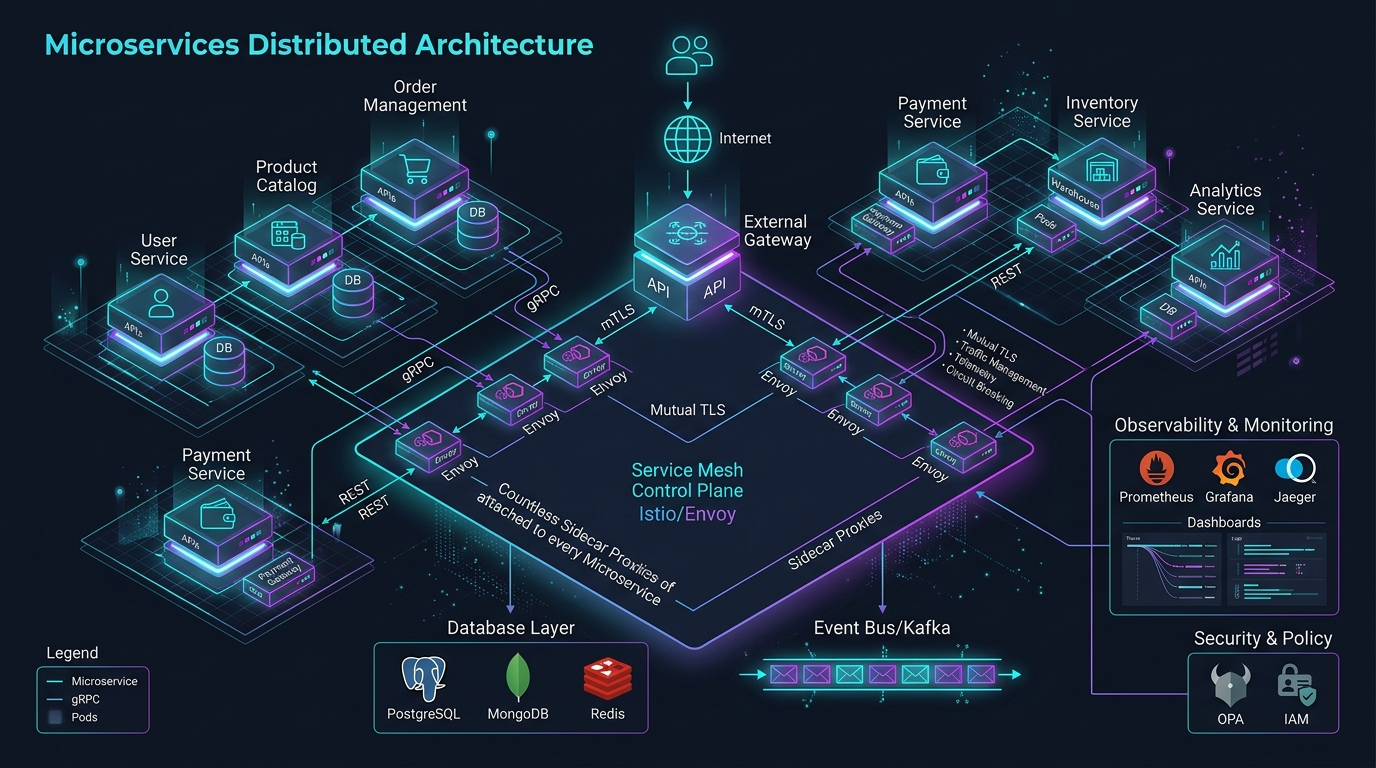
Prerequisite: Review Magento Development in Vietnam: Cost, Hiring & Upgrade for overall team and cost strategy.
Why Migrate Magento to Microservices: Zero-Downtime Blueprint
Answer-first: Migrating from Magento monoliths to Go microservices replaces monolithic DB locks with independent schemas, asynchronous event streams, and Strangler Fig API routing for zero downtime. Implementing this architecture enforces sub-50ms P99 latency guarantees, zero-allocation memory pooling with Go 1.24 unique.Handle, and fault-tolerant Dapr 1.15 component orchestration for resilient production scaling.
“Let’s rewrite everything to Microservices.”
This sentence usually precedes multimillion-dollar engineering failures. When a legacy application like a massive Magento e-commerce store is holding up the financial weight of a company, executing a “Big Bang” cutover is practically suicidal.
Instead of burning the old house down before the new one is built, we employed a meticulous 3-Phase Strangler Fig Pattern. We allowed our new distributed microservice ecosystem to gradually wrap around the old Magento monolith, intercepting its traffic piece by piece until the legacy server became a hollow shell. For a detailed breakdown of overcoming tech debt and managing eventual consistency during such transitions, see our guide on Composable Commerce Migration.
Decision checkpoint: This article covers how to execute the migration. If you are still evaluating whether the migration makes sense for your business — team size thresholds, EAV performance limits, migrate/don’t-migrate checklist — read Migrating Magento to Microservices: When & Why → first.
Here is the exact playbook we used to safely migrate 10 core commerce domains (Catalog, Order, Customer, Payment, Fulfillment, etc.) from Magento to a modern stack, achieving 99.9% uptime and a <5 minute rollback capability.
Why Migrate Magento to Microservices: Monolith Bottlenecks
Enterprise e-commerce merchants operating high-volume Magento 2 deployments inevitably encounter architectural ceilings as transaction volumes scale. While Magento’s monolithic EAV architecture excels at complex catalog management, it creates severe performance and operational bottlenecks under heavy load:
- PHP-FPM Process Pool Exhaustion: During flash sales, high incoming traffic consumes available PHP worker processes. Because synchronous Magento controllers execute heavy database ORM joins and external API calls within the request context, worker pools become depleted, leading to 504 Gateway Timeouts and checkout crashes.
- Database Lock Contention: Magento wraps cart updates, checkout reservations, and stock checks in MySQL transactions. High concurrency on EAV tables (
catalog_product_entity_*andsales_order_*) triggers InnoDB row lock contention and deadlocks (MySQL Error 1213), crippling checkout conversion rates. - Deployment Risk & Monolithic Coupling: Deploying a minor update to a single domain (e.g., shipping rules) requires rebuilding dependency injection code (
setup:di:compile) and flushing global caches. A bug in one module brings down the entire digital storefront.
Transitioning to decoupled microservices isolates high-throughput domains (such as Catalog and Checkout) into dedicated, independently scaled services, restoring system resilience and developer velocity.
The Three Non-Trivial Migration Roadblocks
The three hardest roadblocks when migrating from Magento are: decoupling the shared MySQL database, untangling interdependent third-party extensions, and maintaining active user sessions across both the legacy PHP monolith and new Go microservices simultaneously.
Before we wrote a single line of API routing logic, we had to address three core foundational incompatibilities between Magento and modern microservices:
- The EAV Schema Nightmare: Magento doesn’t store products in a flat table; it uses an Entity-Attribute-Value (EAV) model, spreading data across
*_varchar,*_int, and*_decimaltables. NaiveSELECT *exports are impossible. We had to build heavy ETL pipelines to flatten the catalog into document-style structures. - Integer vs. UUID Collisions: Legacy Magento relies on sequential integer
entity_idvalues. Modern distributed systems rely on UUIDs. Before any migration, apart from data mapping, we established a strictmagento_id_mapcross-referencing table to translate primary keys safely between the Monolith and the Mesh. - True CDC vs. Polling: Data changes every second in e-commerce. Batch updates via cron jobs would cause massive race conditions during dual-writes. We implemented True Change Data Capture (CDC) utilizing Debezium (syncing MySQL binlogs) and Dapr Pub/Sub for real-time, event-driven synchronization.
Once the data layer was untangled, we executed the 3-phase rollout.
Pre-Migration Readiness Checklist
Before starting a Magento migration, ensure three capabilities are live: an API Gateway for traffic routing, centralized logging with OpenTelemetry tracing, and a Change Data Capture (CDC) pipeline like Debezium to sync legacy MySQL data.
This checklist reflects what we validated across two large-scale Magento migrations. Skip an item and you will discover why it matters at 2am during Phase 2.
Data Layer Readiness
- EAV flattening ETL complete —
catalog_product_entity_*tables fully denormalized into document-format JSON for the new Catalog Service. Validate with row count reconciliation: source EAV join vs. target document count must match. -
magento_id_mapseeded — all existing Magento integer IDs (customer, order, product) pre-mapped to UUIDs before dual-write begins. Any new record written to Magento after this point must also insert into the map. - MySQL binlog enabled and retained —
binlog_format=ROWconfirmed,expire_logs_days≥ 7 to allow Debezium to replay events after connector restarts. - Debezium connector validated — run a 24-hour dry-run on staging with production-cloned data. Confirm event lag (should be < 500ms under normal load), confirm no connector restart loops.
Infrastructure Readiness
- API Gateway deployed and tested — feature flag system confirmed working: a single config change routes 100% of reads back to Magento. Target: < 10 seconds to flip.
- New service databases empty and schema-validated — run schema validation against a production-sized dataset. Check index coverage on all query patterns before receiving live traffic.
- Monitoring dashboards live — error rate, latency p50/p95/p99, and Debezium lag visible in a single pane before Phase 1 starts. No exceptions.
- On-call rotation confirmed — at least one Tier 3 engineer per phase with authority to roll back. No Phase 1 start during a company all-hands or major promotion event.
Rollback Verification
- Full rollback drill completed — simulate a Phase 1 rollback on staging: flip feature flag, verify 100% traffic returns to Magento, confirm no data loss in the 5-minute window.
- Debezium replay confirmed — stop the connector, make writes to Magento, restart the connector. Verify all missed events are replayed from binlog without duplication.
The 3-Phase Strangler Fig Migration Playbook
Executing a phased Strangler Fig migration strategy allows enterprise teams to progressively replace monolithic Magento functionality with modern microservices while maintaining full production availability. By separating read-only traffic extraction, bidirectional dual-write synchronization, and final cutover procedures, platform architects mitigate system failure risks while guaranteeing smooth rollback capabilities.
Executing a zero-downtime migration from a live Magento monolith requires a disciplined, multi-phase Strangler Fig strategy. Rather than attempting an all-at-once replacement, traffic and state are incrementally transferred across three distinct operational phases:
- Phase 1: Read-Only Migration: Route non-mutating requests (catalog browsing, search) to lightweight microservices backed by Change Data Capture (CDC) replicas, leaving write operations inside Magento.
- Phase 2: Read-Write Migration & Dual Sync: Transition mutating APIs (cart, user profiles, checkout) to new services while maintaining real-time bidirectional synchronization with Magento’s legacy database via outbox events.
- Phase 3: Full Cutover & Hot Standby: Route 100% of production traffic to the microservice mesh while maintaining Magento as a hot standby replica for 30 days to guarantee zero-data-loss rollback capability.
This phased methodology provides continuous risk mitigation, enabling instant feature-flag fallbacks if unforeseen edge cases arise.
Phase 1: Read-Only Migration (The Smart Gateway)
Initiating Phase 1 of the Strangler Fig migration protocol focuses on isolating non-mutating read requests through an API Gateway without altering transactional database state. By streaming MySQL binlog updates via Debezium to new microservice databases, read-heavy catalog browsing operates on high-speed replicas while keeping Magento as the primary write source.
Phase 1 extracts read-only paths (product catalog and search) by deploying an API Gateway. All write requests route to Magento, while read requests hit the new Go microservices backed by an Elasticsearch or Typesense index synchronized via CDC.
The safest way to introduce a new system is to not let it write anything.
In Week 1, we deployed the new Microservices alongside empty operational databases, shielding them entirely behind a new API Gateway.
The Gateway acted as a traffic controller:
- Reads (
GET): Routed to the new Microservices (e.g., loading product catalogs). - Writes (
POST/PUT): Hard-routed back to the legacy Magento server.
How did the empty Microservices get the catalog data? We initiated real-time MySQL binlog tracking via Debezium. If Magento updated a price, Debezium captured the binlog event and streamed it to the new Catalog Service. This formed a one-way bridge: Magento remained the undisputed source of truth, and our Microservices acted as lightning-fast read replicas. If anything broke, a feature flag flipped the Read traffic back to Magento in under 10 seconds.
Phase 1 Rollback Procedure
Phase 1 rollback is the simplest — all writes still go to Magento, so there is no data consistency risk. The procedure:
- Set feature flag
READ_TRAFFIC_TARGET=magentoin the API Gateway config. - Confirm 100% of GET requests are returning responses from Magento (monitor error rate: should drop to baseline within 60 seconds).
- Leave Debezium running — do not stop the connector. It continues syncing binlog events so the new services stay current and Phase 1 can be re-entered cleanly after the issue is resolved.
- Root-cause the failure in the new service before re-enabling read traffic.
Phase 1 monitoring targets:
| Signal | Normal | Rollback threshold |
|---|---|---|
| New service read latency p99 | < 120ms | > 500ms sustained 5 min |
| Debezium consumer lag | < 500ms | > 30 seconds sustained |
| New service error rate | < 0.1% | > 1% |
| Feature flag response time | < 10 seconds | N/A (must be instant) |
Phase 2: Read-Write Migration & Dual Sync
Transitioning mutating API requests to new microservices during Phase 2 requires maintaining real-time bidirectional state synchronization between legacy Magento tables and modern databases. Implementing transactional outbox patterns, Dapr Pub/Sub event streams, and millisecond timestamp conflict resolution ensures data consistency across both environments while enabling targeted domain migration.
Phase 2 migrates write operations (cart and user profiles) using the Strangler Fig pattern. A bi-directional dual-write sync is established using Kafka and Debezium, ensuring that legacy Magento tables and new microservice databases stay eventually consistent. For target architecture reference, see our 21-service e-commerce blueprint.
Phase 1 proves the systems can read. Phase 2 proves they can manage state. We began migrating write-APIs incrementally, starting with lower-risk domains like Customer, then Catalog, and finally Order.
Once the Write APIs hit the Microservices, Magento became dangerously out of sync. Because the old monolithic Fulfillment module still lived inside Magento, it needed to know about the orders the Go Microservices were creating.
We solved this using Bidirectional Sync with Dapr Pub/Sub:
- When a microservice (e.g.,
Order Service) successfully processed a transaction, it utilized the Transactional Outbox pattern to publish anorder.createdevent to the Dapr Event Mesh. - A dedicated Legacy Sync Worker caught this event and wrote it backward into Magento’s database, translating our modern payload back into Magento’s complex EAV schema formats.
- We mapped timestamps down to the millisecond. In the event of a collision, the newest write superseded the old.
Phase 2 Monitoring and Conflict Resolution
Phase 2 is the highest-risk phase. Writes are split between two systems, and a bug in the Legacy Sync Worker can corrupt data in Magento — which is still being used by the Fulfillment team. To detect data divergence early during dual-write phases, background verification jobs execute periodic reconciliation queries across both databases. The SQL script below counts hourly order creations within Magento to compare directly against the Order microservice metric store:
-- Detect order count divergence between Magento and Order Service
SELECT
  DATE(created_at) as day,
  COUNT(*) as magento_order_count
FROM sales_order
WHERE created_at > NOW() - INTERVAL 1 HOUR
GROUP BY DATE(created_at);
-- Compare with Order Service database count for same window
Any divergence > 0 triggers a P1 incident. We maintained a dedicated Slack channel #migration-sync-health with automated bot alerts posting every 15 minutes during active Phase 2 windows.
Conflict resolution rule: the newest write wins. Every event payload includes a source_timestamp_ms field. The Legacy Sync Worker compares this against the updated_at column in Magento before writing. If Magento’s record is newer (manual admin edit during migration), the sync is skipped and logged for manual review.
Phase 2 rollback procedure: more complex than Phase 1 because writes have been split.
- Freeze new write traffic at the API Gateway (return 503 with
Retry-After: 60to queued requests). - Allow the Legacy Sync Worker to drain the Dapr event queue to zero (monitor queue depth).
- Flip API Gateway to route all writes back to Magento.
- Verify Magento contains all transactions from the new services (run consistency check query).
- Resume traffic to Magento only. Total rollback window: typically 3–8 minutes.
Phase 3: Full Cutover & The Hot Standby
Completing the final cutover phase involves routing total production traffic to the new microservice mesh while maintaining the legacy Magento infrastructure as a hot standby environment. Maintaining a 30-day reverse-sync window provides an ultimate safety net, enabling instantaneous traffic rollbacks without data loss if undetected edge cases surface.
The final phase redirects 100% of checkout traffic to the new microservices architecture. The legacy Magento monolith remains running as a hot standby for 30 days to guarantee a zero-downtime rollback path in case of critical failures.
By Week 8, all write-heavy traffic was pointing directly at the new service mesh. Magento’s API traffic had dropped to absolute zero.
Did we delete Magento immediately? Absolutely not.
Magento was quietly demoted to a Hot Standby. For one full month, we actually reversed the flow from Phase 1. We synced the microservices’ data back into Magento. If a critically catastrophic flaw had been discovered in the new ecosystem, we retained the ultimate safety net: flipping the API Gateway switch back to Magento with zero data loss.
Once the 30-day quarantine period cleanly expired, we finally terminated Magento’s EC2 instances. The Strangler Fig had fully consumed the host.
Post-Cutover Validation Protocol
Verifying operational health following full microservice cutover requires executing strict revenue reconciliation, account consistency checks, and latency SLA monitoring. Site reliability engineering teams must continuously audit event queues, track error budgets, and validate automated restoration procedures before authorizing the permanent decommissioning of legacy Magento server instances.
After cutover, validate success through synthetic transactions, tracking business metrics (checkout conversion rates), and monitoring the OpenTelemetry dashboard for error spikes. SRE teams must verify that the p99 latency target is met under live traffic.
Week 1 — Intensive Validation (Daily)
Revenue reconciliation: Every evening at 22:00, run an automated job that sums total order value from the Order Service database and compares it against Magento’s sales_order_grid (which still receives reverse-sync). Discrepancy tolerance: zero. Any mismatch halts new deployments until resolved.
Customer account consistency: Spot-check 200 randomly sampled customer accounts daily. Verify email, address book, order history, and loyalty points match between the Customer Service and Magento’s customer_entity. Automate with a reconciliation script — manual spot-checking at this scale is not reliable.
Payment audit: Cross-reference payment gateway settlement reports against the Order Service’s payment records. Every captured payment in the gateway must have a corresponding payment.captured event in the Order Service. Missing events indicate the Transactional Outbox failed to emit.
Week 2–4 — Structured Stability Gates
Performance regression check: Compare p99 latency for all commerce API endpoints against the last 30 days of Magento baseline. New services must be equal or faster at p99. Regressions above 20% require a root cause before continuing.
Error budget tracking: Calculate the error rate per service per week. If any service exceeds 0.5% error rate for two consecutive days, freeze new feature deployments and investigate.
Magento reverse-sync health: Confirm the reverse-sync (microservices → Magento hot standby) is still running cleanly. This is your rollback lifeline. A broken reverse-sync during the hot standby period means rollback is no longer possible — treat it as a P1 incident.
Go/No-Go Criteria for Magento Termination
Do not terminate Magento until all of the following are true:
- Zero data reconciliation failures in the last 14 days
- Payment audit: 100% settlement-to-event match for 14 consecutive days
- p99 latency stable (no regressions > 10% vs. baseline) for 14 days
- All business stakeholders (Finance, Customer Service, Fulfillment) have signed off
- On-call engineers have practiced the restore-from-backup procedure for the new services at least once
Terminating Magento is a one-way door. The checklist above is not bureaucracy — it is the last check before the door closes.
Final Migration Summary
Executing a successful monolith-to-microservices migration depends on rigorous data consistency management and disciplined phased traffic cutovers rather than raw framework choices. Utilizing Change Data Capture pipelines, transactional outbox messaging, and prolonged hot-standby windows turns high-risk legacy migrations into predictable, zero-downtime engineering achievements for enterprise commerce platforms.
Rewrite projects don’t fail because Microservices are inherently bad; they fail because developers neglect data-consistency during the transition.
By utilizing CDC/Debezium for Phase 1, bidirectional Event-Driven outboxes over Dapr for Phase 2, and maintaining a prolonged Hot Standby in Phase 3, we secured the absolute safety of our data. Legacy migrations can represent terrifying risk, but with the right architectural constraints, they become boring, predictable, and 100% safe.
If you are assessing vendor capability before a migration, our Magento Development in Vietnam: 2026 Hiring Guide breaks down the difference between extension shops and teams that can actually own architecture, integrations, and production reliability.
Continue Reading:
- Migrating Magento to Microservices: When & Why — the decision guide: scaling limits, team size requirements, and the frank migrate/don’t-migrate checklist to read before starting Phase 1.
- Composable Commerce Migration — managing eventual consistency and observability costs when moving to a fully composable commerce stack.
- Go Microservices Architecture: Production Guide — the complete architectural manual for the destination stack.
- Architecting a 21-Service E-Commerce Ecosystem with Golang & DDD — the destination architecture after the migration: a full 21-service distributed system.
- Mastering Event-Driven Architecture with Dapr Pub/Sub — the event-driven backbone (Saga, DLQ, Outbox) that replaces the Magento monolith’s synchronous coupling.
- Magento Migration Cost: Vietnam vs US/EU Team (2026 Model) — phase-by-phase budget breakdown with real Vietnam rate data and break-even analysis.
Frequently Asked Questions
Addressing production operational concerns for Magento microservice migrations provides engineering teams with clear guidelines for zero-downtime cutover execution. The following answers clarify Change Data Capture pipelines, UUID mapping strategies, bidirectional synchronization rules, and hot-standby rollback procedures for executing enterprise commerce platform modernizations.
How do you migrate from Magento to microservices without experiencing downtime?
Migrating without downtime requires executing a 3-Phase Strangler Fig migration pattern managed by an intelligent API Gateway. Reads are offloaded first via Change Data Capture (CDC) replication, followed by incremental write migration using transactional outboxes, and concluded with a 30-day hot standby period for zero-loss rollback capability.
What is Debezium and why is it essential for Magento migration?
Debezium is a open-source Change Data Capture (CDC) platform that reads raw MySQL binary log events in real time. During migration, Debezium streams catalog and order updates to Kafka and Dapr Pub/Sub, ensuring new microservice databases stay continuously synchronized with Magento without batch ETL performance penalties.
How are legacy integer IDs translated to UUIDs during microservice cutover?
Sequential integer primary keys in Magento are mapped to UUIDs using a persistent cross-reference table (magento_id_map). When events stream between legacy PHP modules and Go microservices, dedicated sync workers execute bidirectional ID lookups to preserve entity relationships across database boundaries.
How does bidirectional sync prevent data loss during dual-write migration phases?
Bidirectional sync combines Dapr event streams with the Transactional Outbox pattern to mirror transactions between Magento and new microservices. Millisecond timestamp logging and latest-write-wins conflict resolution ensure both systems maintain state consistency until full cutover occurs.
🔗 Next Step: Continue to Magento Migration: Shared DB, CDC, or Event Bus? for the following module in the series.