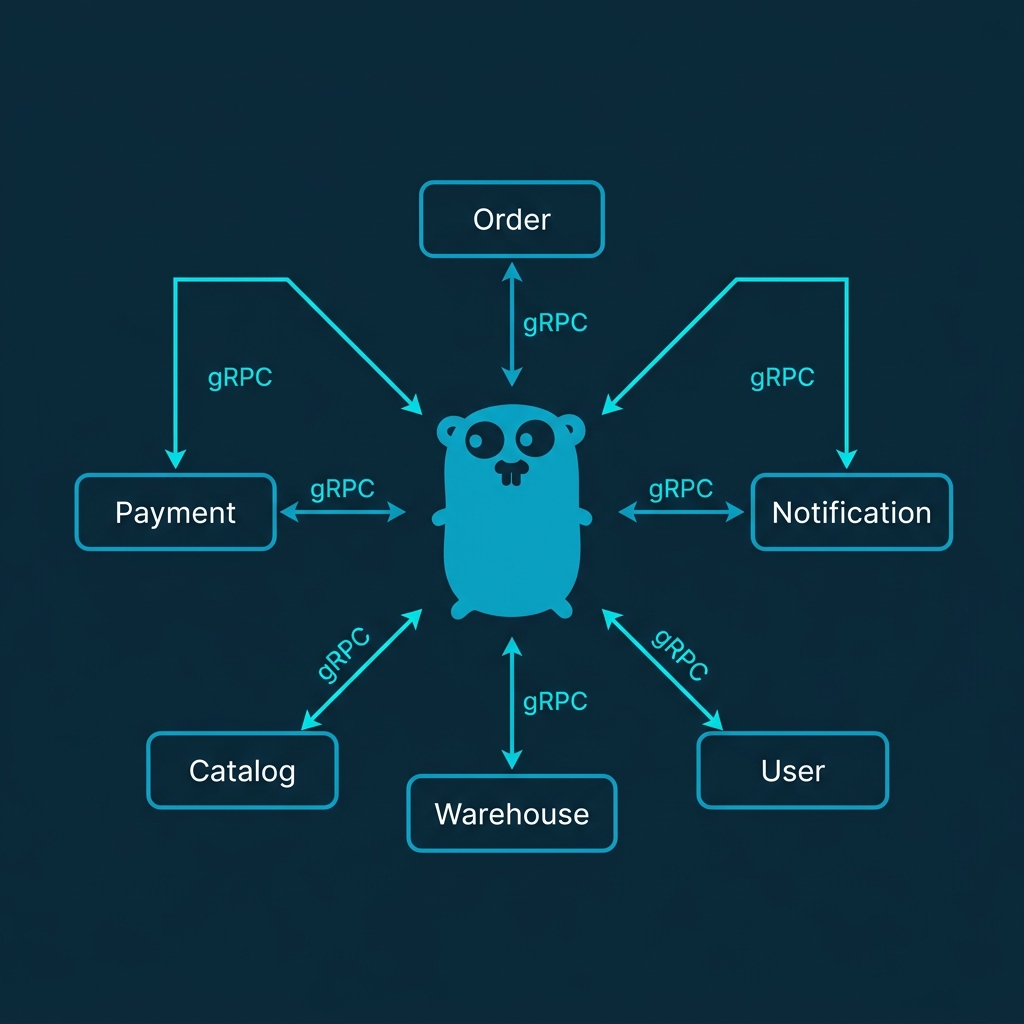
Choosing Go for microservices is an architecture decision, not a language preference. The goroutine model, binary size, and serialization speed change what the deployment unit looks like at the infrastructure level.
Go’s goroutine model and near-zero serialization overhead make it one of the strongest languages for microservices at scale. This guide covers the architecture decisions, technology stack, and production patterns — from domain decomposition through Dapr Pub/Sub, gRPC contracts, distributed tracing, and GitOps deployment — based on a real 21-service e-commerce migration at Lotte Innovate Vietnam.
What you will get from this guide: Concrete architecture decisions with production rationale, not generic tutorial content. Every pattern here was stress-tested on a system handling 150K RPM during peak flash sale traffic.
Why Go for Microservices?
Answer-first: Go’s compile-time binary output (~15MB), goroutine scheduler (~2KB initial stack), and sub-microsecond JSON marshaling make it the default choice for latency-sensitive microservices. It delivers predictable GC pauses and ultra-fast container startup times compared to JVM-based alternatives — and its operational simplicity is underrated.
The performance case
The numbers that matter in production:
- Goroutine overhead: A goroutine starts with a ~2KB dynamic stack, compared to a ~1MB fixed stack for a Java thread. A single 16GB RAM node can run 100K+ concurrent goroutines without swapping. This is not theoretical — the Order service in our migration handled 50K concurrent checkout sessions on a single
e2-standard-8GCP node during our first major flash sale. - Binary output: Go compiles to a single static binary with no JVM warmup. Cold start time is approximately 10ms. Spring Boot microservices in our pre-migration system took 2–5 seconds to start — meaning Kubernetes rolling deployments were slower, pod evictions were more expensive, and autoscaling response time was worse by a full order of magnitude.
- Garbage Collection: Go’s concurrent mark-and-sweep GC targets sub-millisecond pauses (Go 1.21+). The Go 1.26 “Green Tea” collector further reduces tail latency by improving pacing under allocation bursts. Compared to JVM Stop-the-World pauses (which can reach 200–400ms during full GC cycles on heap-heavy services), this is a qualitative difference in P99 latency.
The operational case
- Docker image size: Using
FROM scratchplus a static Go binary yields a container image of ~15MB. JVM images range from 200–400MB. At 21 services running across 3 environments (dev, staging, prod), this represents over 10GB in image registry savings — and meaningfully faster CI pipeline times. - Kubernetes resource efficiency: Smaller images and near-zero warmup mean faster pod startup on node failures, tighter memory limits, and better bin-packing on worker nodes. Our Go services run at 50–150MB RAM steady-state; equivalent Java services ran at 512MB–1.5GB.
- No runtime dependency: One binary is the complete deployment artifact. No JVM version management, no classpath hell, no
java.lang.NoClassDefFoundErrorat 2 AM.
When Go is NOT the right choice
Go is exceptional for network and infrastructure layers. It struggles in:
- Heavy ML and data processing — Python’s NumPy, PyTorch, and scikit-learn ecosystem is unmatched for model training and inference pipelines.
- Rapid CRUD prototyping with complex ORM — Rails, Laravel, or Django offer dramatically faster initial development velocity for CRUD-heavy admin tools.
- Teams without Go experience — The hiring pool and onboarding cost matter. A team fluent in Java that is forced onto Go will produce Go code that looks like Java and performs like neither.
Domain Decomposition — Getting the Boundaries Right
Answer-first: Wrong service boundaries are the #1 cause of microservice failure. A service that requires 3 synchronous network calls to complete a single business operation is not independent — it is a distributed monolith with added network latency, added operational complexity, and none of the deployment independence that justifies the architecture.
DDD Bounded Context as the decomposition unit
Every microservice must map to exactly one Domain-Driven Design (DDD) Bounded Context with its own dedicated database. There is strictly no shared database between services — we enforced this via Kubernetes NetworkPolicy rules in the migration, and it prevented the most common decomposition anti-pattern from ever becoming tempting.
Our 21-service decomposition after the Magento migration:
| Domain | Service | Database | Key responsibility |
|---|---|---|---|
| Commerce | Order | PostgreSQL | Order lifecycle, state machine |
| Commerce | Cart | Redis + PostgreSQL | Session cart, persistent cart |
| Catalog | Product | PostgreSQL + OpenSearch | Product data, search indexing |
| Inventory | Stock | PostgreSQL + Redis | Stock levels, reservations, ATP |
| Pricing | Price | PostgreSQL | Price rules, customer group pricing |
| Fulfillment | Shipping | PostgreSQL | Carrier integration, label generation |
| Payment | Payment | PostgreSQL | Payment gateway, refunds |
| Identity | Auth | PostgreSQL | JWT issuance, session management |
| Communication | Notification | PostgreSQL + SQS | Email, SMS, push |
| Reporting | Analytics | ClickHouse | Sales reports, inventory reports |
The domain boundaries are the hard part. Technology selection is secondary.
The service size heuristic
Two questions that determine if a service is sized correctly:
- “Can one team own this service end-to-end — on-call, feature development, and deployment?” → Yes = correct size. If the answer requires multiple teams, the service is too large (split it) or the team structure needs rethinking.
- “Does this service need to be deployed independently 5x/day without coordinating with other teams?” → Yes = the boundary is correct. Deployment coordination between services is the primary symptom of wrong boundaries.
The anti-pattern that kills microservices projects: micro-microservices that require coordinated deployments. If deploying Service A always requires deploying Service B at the same time, your boundary is wrong — A and B are actually one bounded context split across two deployment units. Merge them.
Data ownership rules
This is non-negotiable: a service owns its data and writes only through its own API.
Cross-service reads work via one of:
- Asynchronous events + eventual consistency — the Catalog service publishes
product.price.updatedevents; downstream services update their local materialized view. - Synchronous gRPC query — the Order service queries the Price service for the current price at checkout time, where eventual consistency is not acceptable.
- Reporting via CDC — Debezium streams change events from each service’s PostgreSQL to a shared ClickHouse cluster for analytics. The reporting service reads from ClickHouse, never from operational databases.
What never happens: cross-database JOINs, shared schema, or shared ORM models.
Read more: Architecting 21-Service E-commerce with DDD
Inter-Service Communication — REST, gRPC, or Events?
Answer-first: The answer depends on the communication pattern: synchronous request-response for real-time queries (gRPC), asynchronous event broadcast for state changes (Dapr Pub/Sub + Kafka), and REST for external clients. Most production Go microservice systems use all three — the mistake is applying one pattern everywhere.
| Pattern | Use case | Go library | Latency | Coupling |
|---|---|---|---|---|
| gRPC | Sync service-to-service | google.golang.org/grpc | <1ms (protobuf) | Tight (proto contract) |
| REST/HTTP | External clients, webhooks, public API | net/http + chi or gin | 1–5ms | Loose |
| Dapr Pub/Sub | Async events, state change broadcast | dapr/go-sdk | 1–5ms (sidecar) | Decoupled |
| Direct Kafka | High-throughput streams, CDC | confluent-kafka-go | <1ms | Medium |
gRPC for Go microservices — what production looks like
gRPC is used for critical synchronous paths: Checkout → Price, Checkout → Inventory, Order → Auth.
The production setup:
- Protobuf contract-first design: Every service-to-service interface is defined in
.protofiles stored in a sharedapi/repository. The schema registry enforces backward compatibility via field addition rules — you can add fields, never remove or change field numbers. - mTLS handled by the sidecar: Dapr’s sidecar handles mutual TLS between services transparently. Go service code contains no TLS configuration — the sidecar handles identity and encryption at the network layer.
- Bidirectional streaming for real-time push: The Inventory service uses gRPC bidirectional streaming to push stock level updates to the Cart service during checkout. This eliminates polling and reduces inventory inconsistency windows from seconds to milliseconds.
The trade-off: gRPC creates tight coupling. When the Price service changes a response field, all callers must update their generated client code. This is acceptable when the services are owned by the same team — it becomes painful when crossing team boundaries.
Dapr Pub/Sub — the abstraction layer that earns its keep
Dapr is the most opinionated choice in our stack, and also the one I most consistently recommend to teams starting from scratch.
The core value proposition: Dapr abstracts the message broker entirely. We use Redis locally and Kafka in production — the Go service code changes not at all, only the Dapr component YAML changes. This matters for local development velocity.
What Dapr provides out of the box that would otherwise require boilerplate in every Go service:
- Retry with configurable exponential backoff
- Dead Letter Queue routing on repeated failure
- Message deduplication via idempotency key
- At-least-once delivery guarantee
The trade-off: the Dapr sidecar adds ~1ms overhead per call and is an additional operational component. We consider this acceptable — the sidecar overhead is negligible compared to the time saved not writing retry/backoff/DLQ code in every service.
Read more: Golang gRPC Microservices: Production Guide
Read more: Mastering Event-Driven Architecture with Dapr
Distributed Transactions — The Saga Pattern
Answer-first: You cannot use ACID transactions across service boundaries. The Saga pattern replaces them with a sequence of local transactions and compensating actions. In Go, implement choreography via Dapr events for simple flows (2–4 steps) and Dapr Workflow orchestration for complex branching logic (5+ steps).
Choreography Saga — simple flows
The checkout flow uses choreography because the steps are linear and the compensation logic is straightforward:
- Checkout service publishes
checkout.order.created(with order ID, SKU list, quantities, customer ID). - Inventory service subscribes → reserves stock → publishes
inventory.reservedon success orinventory.reservation.failedon stock unavailability. - Payment service subscribes to
inventory.reserved→ charges the card → publishespayment.completedorpayment.failed. - Order service subscribes to
payment.completed→ confirms the order → publishesorder.confirmed.
On failure: compensating events propagate backwards. payment.failed triggers an inventory.release command. The Inventory service releases the reservation. The Checkout service marks the order as failed and notifies the customer.
The key implementation requirement: every event consumer must be idempotent. If the Inventory service receives checkout.order.created twice (due to Kafka at-least-once delivery), it must not double-reserve stock. We implement this via a PostgreSQL outbox_processed table that tracks processed event IDs.
Dapr Workflow Saga — complex flows with branching
For the B2B order flow — which involves credit limit checks, manager approval gates, multi-warehouse allocation, and ERP sync — choreography becomes unmaintainable. The branching logic and compensation requirements exceed what event chains can express clearly.
Dapr Workflow acts as a durable orchestrator:
// B2B Order Workflow — simplified
func B2BOrderWorkflow(ctx workflow.Context, input *B2BOrderInput) (string, error) {
    // Step 1: Credit check (synchronous activity)
    creditResult, err := workflow.ExecuteActivity(ctx, CheckCreditLimit, input.CompanyID, input.OrderTotal)
    if err != nil || !creditResult.Approved {
        return "", fmt.Errorf("credit limit exceeded: %w", err)
    }

    // Step 2: Manager approval gate (waits for external event)
    var approval ApprovalEvent
    workflow.GetExternalEvent(ctx, "manager.approval", &approval)
    if !approval.Approved {
        // Compensate: notify customer, release reservations
        workflow.ExecuteActivity(ctx, NotifyRejection, input.OrderID)
        return "rejected", nil
    }

    // Step 3: Multi-warehouse allocation
    allocationResult, err := workflow.ExecuteActivity(ctx, AllocateInventory, input.Items)
    // ... continues
}
The critical property: Dapr Workflow state is persisted to the configured state store (PostgreSQL in production) after each step. If the service crashes mid-workflow, the orchestrator replays from the last persisted checkpoint — not from the beginning.
The Transactional Outbox — solving the dual-write problem
The dual-write problem: after a service writes to its database, it must also publish an event. If the service crashes between the write and the publish, the event is lost — but the state change is committed. This creates permanent inconsistency.
The solution: write the business state and an outbox event record in the same local database transaction. A CDC tool (Debezium in our stack) reads the outbox table and publishes to Kafka. The event is guaranteed to be published if and only if the state is committed.
-- In the same transaction:
INSERT INTO orders (id, status, customer_id, total) VALUES ($1, 'created', $2, $3);
INSERT INTO outbox_events (aggregate_id, event_type, payload)
  VALUES ($1, 'order.created', $4);
-- Debezium reads outbox_events and publishes to Kafka
Read more: Dapr Workflow Saga Orchestration Guide
Observability — Tracing, Metrics, and Profiling
Answer-first: In a 21-service system, a 500ms latency spike has no visible cause in any single service’s logs. Distributed tracing with W3C trace context propagation across Kafka topics, gRPC headers, and HTTP calls is the only way to reconstruct a request’s full journey through the system.
We learned this the hard way during the first month of production. A checkout latency regression appeared — P95 at 450ms, up from 80ms. The issue was in the Pricing service’s interaction with the Price Rules caching layer, but the symptom was visible only in the Checkout service’s response time. Without distributed tracing, we would have spent days looking in the wrong place.
OpenTelemetry in Go microservices
Our observability stack:
- SDK:
go.opentelemetry.io/otelfor traces and metrics - Auto-instrumentation:
otelgrpcinterceptor for all gRPC calls;otelhttpmiddleware for HTTP handlers - Collector: OpenTelemetry Collector deployed as DaemonSet, receiving from all service pods
- Backend: Grafana Tempo for traces, Prometheus for metrics, Loki for logs
The non-obvious requirement: trace context must propagate across Kafka message boundaries. When the Checkout service publishes an event, the current span context must be serialized into the Kafka message headers. The Inventory service must extract that context when consuming the message and create a child span. Without this, the trace breaks at every async boundary.
// Publishing: inject trace context into Kafka headers
span := trace.SpanFromContext(ctx)
headers := []kafka.Header{}
otel.GetTextMapPropagator().Inject(ctx, kafkaHeaderCarrier(headers))
producer.Produce(&kafka.Message{
    Headers: headers,
    Value:   eventBytes,
})

// Consuming: extract trace context from Kafka headers
parentCtx := otel.GetTextMapPropagator().Extract(
    context.Background(),
    kafkaHeaderCarrier(msg.Headers),
)
ctx, span := tracer.Start(parentCtx, "inventory.process_reservation")
defer span.End()
pprof in production Kubernetes
Every Go service exposes net/http/pprof on an internal admin port (:6060). This is never exposed via the public ingress — only accessible via kubectl port-forward.
Profiles collected in production incidents:
- goroutine: The most valuable profile. Reveals goroutine count, blocked goroutines, and where each one is blocked. Used to diagnose the goroutine leak that caused our first OOM (
exit status 137) in the Notification service. - heap: Reveals current heap allocations and the allocation sites generating the most garbage. Used to identify a hot path that was allocating 4MB of JSON per checkout due to over-fetching in a GraphQL resolver.
- CPU (30s sample): Reveals which functions consume the most CPU cycles. Used to identify a bcrypt call in the Auth middleware that was running on every gRPC request, not just login endpoints.
Go 1.25 Flight Recorder for production incidents
Go 1.25 introduced runtime/trace.FlightRecorder — a low-overhead, rolling in-memory ring buffer of execution trace data. This is now standard in all our services:
// Start at application startup
fr := trace.NewFlightRecorder(trace.FlightRecorderConfig{
    MinAge:   10 * time.Second,
    MaxBytes: 10 << 20, // 10MB ring buffer
})
fr.Start()

// On incident detection (health check failure, latency spike alert):
func dumpTrace(w http.ResponseWriter, r *http.Request) {
    f, _ := os.CreateTemp("", "trace-*.out")
    fr.WriteTo(f)
    // Upload to GCS bucket for analysis
}
The Flight Recorder captures goroutine scheduling events, GC pauses, and lock contention in a 10MB rolling window — with overhead below 1% CPU. It gives us a 10-second window of execution data at the moment of any incident, without requiring the high overhead of full-time tracing.
Goroutine leak prevention
The production goroutine leak protocol:
- CI gate:
go.uber.org/goleakinTestMaincatches goroutine leaks before code merges. - Production metric: Every service exports
go_goroutinesto Prometheus. Alert fires at>20% growth over 1 hour baseline. - On alert:
kubectl port-forwardto:6060, collect goroutine profile, analyze withgo tool pprof.
The most common goroutine leak pattern we encounter: a goroutine that starts a blocking network call (Redis, PostgreSQL, external API) without a context deadline. The call blocks indefinitely, the goroutine stack persists, and the count grows monotonically until OOM.
The fix is always the same: every blocking call must use a context with a timeout or deadline.
// Wrong — goroutine leaks if Redis is unresponsive
go func() {
    val, _ := redisClient.Get(key).Result()
    // ...
}()

// Correct — goroutine respects cancellation and deadline
go func() {
    ctx, cancel := context.WithTimeout(parentCtx, 2*time.Second)
    defer cancel()
    val, err := redisClient.Get(ctx, key).Result()
    if err != nil {
        // handle timeout, log, continue
    }
}()
Read more: Go Microservices Distributed Tracing Architecture
Read more: Goroutine Leak Detection in Production Go
Concurrency Patterns — Goroutines Done Right
Answer-first: Go’s concurrency model enables massive throughput — but only if goroutine lifecycles are strictly managed. Production services must use bounded worker pools with backpressure, context-aware cancellation on every blocking call, and graceful shutdown on SIGTERM. Unmanaged goroutines are a memory leak waiting for a high-traffic event to surface it.
Worker pool with errgroup
The bounded worker pool is the most important concurrency pattern in production Go microservices. It prevents unbounded goroutine creation under load:
// Pattern: bounded worker pool — limits max concurrency to maxWorkers
func processItems(ctx context.Context, items []Item, maxWorkers int) error {
    g, ctx := errgroup.WithContext(ctx)
    sem := make(chan struct{}, maxWorkers)

    for _, item := range items {
        item := item // capture loop variable
        g.Go(func() error {
            sem <- struct{}{} // acquire semaphore slot
            defer func() { <-sem }() // release on return
            return processItem(ctx, item)
        })
    }

    return g.Wait() // blocks until all goroutines complete or first error
}
The sem channel acts as a backpressure mechanism: if all maxWorkers slots are occupied, new goroutines block at sem <- struct{}{} rather than spawning unconstrained. This prevents a single burst of 50,000 incoming Kafka messages from spawning 50,000 concurrent goroutines that collectively exhaust the available PostgreSQL connection pool.
Context propagation — the rule that prevents 80% of production issues
Every function that performs I/O must accept context.Context as its first parameter and pass it to all downstream calls. This is not a convention in Go — it is the mechanism that allows:
- Request cancellation: When a client disconnects, the request context is cancelled. All downstream database calls, Redis calls, and gRPC calls are cancelled automatically.
- Deadline propagation: A 2-second HTTP request deadline propagates through the call chain — the Order service has 2s total, the Price service call gets 500ms of that, the database query gets 200ms of that.
- Trace context propagation: OpenTelemetry span data travels through the context.
Graceful shutdown pattern
Every Go service must handle SIGTERM gracefully — Kubernetes sends SIGTERM before forcibly killing a pod. Without graceful shutdown, in-flight requests are abruptly terminated, leading to failed checkouts, incomplete order records, and unhappy customers.
func main() {
    // Create context that is cancelled on SIGTERM or SIGINT
    ctx, stop := signal.NotifyContext(context.Background(), syscall.SIGTERM, syscall.SIGINT)
    defer stop()

    srv := &http.Server{Addr: ":8080", Handler: router}

    // Start server in goroutine
    go func() {
        if err := srv.ListenAndServe(); err != http.ErrServerClosed {
            log.Fatal(err)
        }
    }()

    // Wait for shutdown signal
    <-ctx.Done()

    // Allow 10 seconds for in-flight requests to complete
    shutdownCtx, cancel := context.WithTimeout(context.Background(), 10*time.Second)
    defer cancel()
    srv.Shutdown(shutdownCtx)

    // Drain worker pools, close Kafka consumers, flush telemetry
    cleanup()
}
Read more: Goroutine Pool Patterns: errgroup & Backpressure
Deployment — Kubernetes + GitOps with ArgoCD
Answer-first: A Go microservice deployment that is not GitOps is a liability. When a pod fails at 2 AM, you need deterministic, auditable rollback — not a frantic kubectl apply -f from someone’s laptop. ArgoCD with ApplicationSets provides a declarative source-of-truth for managing 21+ services without per-service pipeline complexity.
Go-specific Kubernetes optimization
Image build: Every Go service uses a multi-stage Dockerfile. Build stage compiles the binary with CGO disabled (required for FROM scratch). Final stage copies only the binary:
FROM golang:1.26-alpine AS builder
WORKDIR /app
COPY go.mod go.sum ./
RUN go mod download
COPY . .
RUN CGO_ENABLED=0 GOOS=linux go build -o service ./cmd/service

FROM gcr.io/distroless/static-debian12
COPY --from=builder /app/service /service
ENTRYPOINT ["/service"]
Result: ~18MB image, no shell, no package manager, minimal attack surface.
Resource limits: Go services in our cluster run with these limits, which reflect actual steady-state usage:
resources:
  requests:
    memory: "64Mi"
    cpu: "50m"
  limits:
    memory: "256Mi"    # P99 heap stays well below this
    cpu: "500m"        # Burst headroom for GC cycles
Setting GOMEMLIMIT to 80% of the memory limit (204Mi in this case) prevents OOM kills by making the GC more aggressive before hitting the hard limit: env: [{name: GOMEMLIMIT, value: "204MiB"}].
Health probes:
livenessProbe:
  httpGet:
    path: /healthz    # Returns 200 if process is alive (no dependency checks)
    port: 8080
  initialDelaySeconds: 5
  periodSeconds: 10

readinessProbe:
  httpGet:
    path: /readyz     # Returns 200 only if DB + Kafka connections are ready
    port: 8080
  initialDelaySeconds: 10
  periodSeconds: 5
The distinction matters: liveness checks process health (is the binary running?); readiness checks traffic eligibility (is the service ready to receive requests?). A service that is live but not ready (e.g., still connecting to PostgreSQL on startup) will be excluded from load balancer rotation until /readyz returns 200.
ArgoCD ApplicationSets for 21-service scale
Instead of maintaining 21 separate ArgoCD Application manifests, we use a single ApplicationSet with a Git directory generator:
apiVersion: argoproj.io/v1alpha1
kind: ApplicationSet
metadata:
  name: services-production
spec:
  generators:
  - git:
      repoURL: https://github.com/org/platform
      revision: HEAD
      directories:
      - path: deploy/services/*   # Each subdirectory = one service
  template:
    spec:
      project: production
      source:
        repoURL: https://github.com/org/platform
        targetRevision: HEAD
        path: "deploy/services/{{path.basename}}"
      destination:
        server: https://kubernetes.default.svc
        namespace: "{{path.basename}}"
      syncPolicy:
        automated:
          prune: true    # Remove resources not in Git
          selfHeal: true # Revert manual kubectl changes
Adding a new service requires one new directory under deploy/services/. The ApplicationSet generates the ArgoCD Application automatically on the next sync cycle.
Progressive delivery for critical services: We use Argo Rollouts for the Checkout and Payment services, where a bad deployment has direct revenue impact:
- Canary: 10% of traffic → monitor error rate and P99 latency for 5 minutes → 50% → 100%.
- Automatic rollback: triggers if error rate exceeds 1% or P99 exceeds 500ms during the canary window.
- Manual gate: Checkout service requires explicit engineer approval to advance from 50% → 100%.
Read more: GitOps at Scale: Kubernetes & ArgoCD
Resilience Patterns — Circuit Breaking and Retry
Answer-first: In a distributed system, a downstream service that becomes slow is often more dangerous than one that fails fast. A slow Inventory service holding open database connections will cause Checkout goroutines to pile up, exhaust the connection pool, and cascade the failure to the Order service. Circuit breaking prevents this.
Circuit breaker with gobreaker
sony/gobreaker is the standard Go implementation of the Circuit Breaker pattern:
var cb = gobreaker.NewCircuitBreaker(gobreaker.Settings{
    Name:        "inventory-service",
    MaxRequests: 5,                // Requests allowed in half-open state
    Interval:    30 * time.Second, // Window for counting failures
    Timeout:     60 * time.Second, // Time in open state before retry
    ReadyToTrip: func(counts gobreaker.Counts) bool {
        failureRatio := float64(counts.TotalFailures) / float64(counts.Requests)
        return counts.Requests >= 10 && failureRatio >= 0.5
    },
})

func getInventoryLevel(ctx context.Context, sku string) (*Inventory, error) {
    result, err := cb.Execute(func() (interface{}, error) {
        return inventoryClient.GetLevel(ctx, sku)
    })
    if err == gobreaker.ErrOpenState {
        // Circuit is open — return cached data or graceful degradation
        return getCachedInventory(sku), nil
    }
    return result.(*Inventory), err
}
When the circuit opens (after 50% failure rate over 10 requests), calls to the Inventory service immediately return the cached value rather than waiting for a timeout. This prevents goroutine accumulation and allows the Checkout service to continue serving traffic with slightly stale inventory data — far preferable to complete checkout failure.
Retry with exponential backoff
Transient failures — momentary network hiccups, brief database connection issues — should be retried. Permanent failures — validation errors, authentication failures — should not. The distinction matters:
func withRetry(ctx context.Context, op func() error) error {
    backoff := time.Second
    maxBackoff := 30 * time.Second

    for attempt := 0; attempt < 5; attempt++ {
        err := op()
        if err == nil {
            return nil
        }

        // Do not retry permanent errors
        if isNonRetryable(err) {
            return err
        }

        select {
        case <-ctx.Done():
            return ctx.Err()
        case <-time.After(backoff + jitter()):
            backoff = min(backoff*2, maxBackoff)
        }
    }
    return fmt.Errorf("operation failed after 5 attempts")
}
Jitter is critical to prevent thundering-herd: if 100 services all retry simultaneously after a brief outage, the burst can re-trigger the outage. Adding random jitter (±20% of the backoff interval) spreads the retry load.
When Microservices is Wrong for Your Team
Answer-first: Microservices add operational complexity that kills teams lacking DevOps maturity. If you cannot deploy a service independently in under 10 minutes, you are not ready for microservices — build a well-structured modular monolith first and extract services when you have specific, evidence-based scaling requirements.
Signals you are NOT ready
- No automated CI/CD per service. Manual deployment processes do not scale beyond 3 services.
- Shared database across services. If two services write to the same schema, you have a distributed monolith, not microservices.
- No distributed tracing. Without tracing, debugging cross-service issues is nearly impossible.
- No on-call rotation that covers service boundaries. Teams must own their services in production.
- Team size under 8 engineers. Conway’s Law applies — your architecture will mirror your communication structure. A 4-person team does not have the bandwidth to own 20 services.
When to start the microservices journey
Start when you have concrete, observable pain points — not because microservices are trendy:
- Deployment coupling becomes expensive: A change to the Catalog service requires a full platform release that disrupts checkout. Independent deployability becomes a genuine business requirement.
- Failure isolation fails: An error in the Promotion service cascades and takes down order processing. Domain boundaries need to be real fault boundaries.
- Scaling requirements diverge drastically: The Search service needs 10x the resources of the Auth service during flash sales. Unified scaling is wasteful.
- Team ownership becomes blurry: As the codebase grows, engineers are afraid to modify modules outside their area. Service ownership restores clarity.
The Strangler Fig pattern is the right migration path from a working monolith: identify one bounded context, extract it as a standalone service, route traffic to it via API Gateway, and verify in production before extracting the next domain. Do not attempt a big-bang rewrite.
FAQ
context.Context with a deadline or timeout to every blocking call — uncontrolled blocking is the primary leak cause. (2) Use go.uber.org/goleak in TestMain to catch leaks in CI before merging. (3) Monitor go_goroutines in Prometheus and alert on sustained growth above 20% of baseline over one hour — this signals a leak in progress.confluent-kafka-go) gives maximum performance and control but requires writing retry logic, dead letter queue handling, backoff, and circuit breaking in every service. Dapr abstracts the broker and provides these resilience features out-of-the-box via a sidecar — you can switch from Redis to Kafka to AWS SQS by changing a YAML file. The Dapr sidecar adds ~1ms overhead per call, which is acceptable for most workloads. Use direct Kafka only when you need sub-millisecond throughput or specific Kafka features Dapr does not expose.go.opentelemetry.io/otel). Add otelgrpc interceptors to all gRPC servers and clients, and otelhttp middleware to all HTTP handlers. Crucially, propagate W3C trace context across Kafka message boundaries by serializing the current span into message headers on publish and extracting it on consume. Export spans to an OpenTelemetry Collector and backend such as Grafana Tempo or Jaeger.