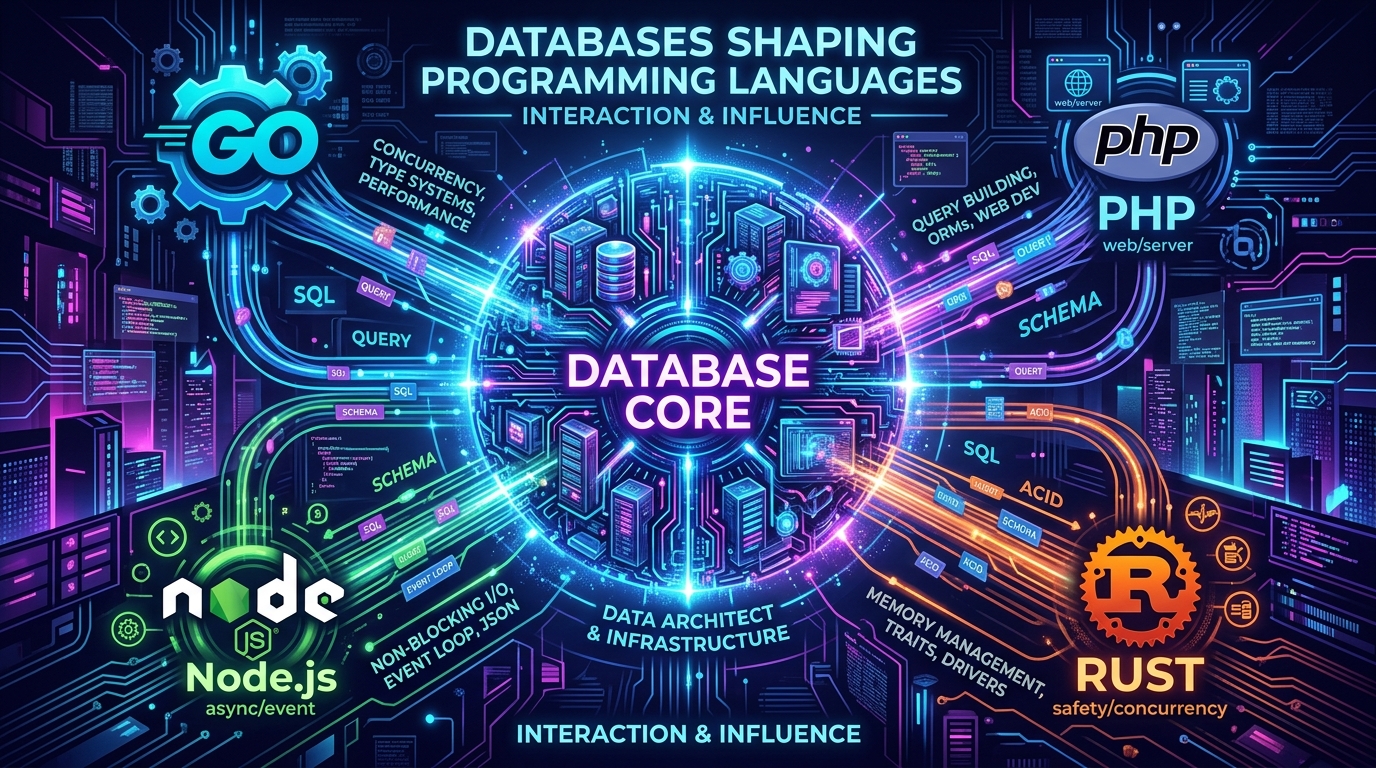
How Databases Shaped Go, PHP, Node.js, and Rust
Answer-first: Database paradigms directly shape programming language design, driving memory allocation models, asynchronous I/O frameworks, ORM abstractions, and connection pool patterns across modern systems.
Databases are the most critical I/O bottleneck in backend systems. Over the past 20 years, network latency, connection limits, and transaction safety have forced programming languages to rethink their concurrency models, evolve new syntaxes, and invent smarter ORMs.
Here is a deep architectural breakdown of how database constraints drove the evolution of PHP, Node.js, Rust, and Go.
1. Connection Models & Concurrency
Process-per-request models exhaust physical database connections under heavy load; languages with embedded multiplexed connection pools avoid saturating downstream database clusters.
PHP: The “Share-Nothing” Burden
PHP (via PHP-FPM) operates on a Share-Nothing architecture. Each HTTP request spins up an isolated, short-lived process. Because processes cannot share memory, PHP cannot maintain a global connection pool. At 10,000 requests per second, PHP attempts to open 10,000 TCP connections, instantly crashing MySQL or PostgreSQL. This forced the ecosystem to rely heavily on infrastructure-level multiplexers like PgBouncer or ProxySQL.
Node.js & Python: The Single-Threaded Event Loop
Node.js and Python use a single-threaded Event Loop. A slow, synchronous SQL query blocks the entire thread, halting all other requests. This specific database I/O problem forced the Node.js community to invent Callbacks and Promises to yield the CPU while waiting for database responses.
Go: Intrinsic Thread Pools
Go uses extremely lightweight Goroutines. To prevent millions of Goroutines from opening millions of database connections, Go integrated a highly high-performance connection pool directly into its Standard Library (database/sql). Go runtime automatically yields the CPU during database waits, allowing developers to write seemingly synchronous code without thread-blocking.
Serverless Blind Spot: Connection pooling is ultimately a compute platform problem. If you deploy Go or Node.js to AWS Lambda (Serverless), they revert to the exact same Share-Nothing model as PHP. You still need RDS Proxy or PgBouncer.
2. Type Safety and the Evolution of ORM Design
Language ORMs have shifted away from dynamic reflection toward compile-time static code generation. Moving from heavy ActiveRecord-style patterns to code-generated SQL interfaces cuts runtime type mismatches and makes query execution more predictable.
- Dynamic ORMs (ActiveRecord/Eloquent): Ruby and PHP traditionally used dynamic reflection to map database columns to objects on the fly. This provides high developer velocity but sacrifices performance and causes N+1 query problems at scale.
- Static Code Generation (Go/Rust): Modern languages abandoned heavy ORMs. In Go, tools like
sqlcread raw SQL and generate 100% type-safe code. In Rust, Diesel and SQLx validate queries against a live database during compile-time. If the SQL is wrong, the code will not build.
3. Memory Models & Garbage Collection Churn
Object-relational mappers that instantiate thousands of heap objects per row can trigger noticeable GC latency spikes on high-frequency queries. Modern high-performance languages avoid this by deserializing raw socket byte streams directly into contiguous memory structures.
Querying 10,000 rows in a traditional ORM allocates 10,000 complex objects (data + metadata + methods) on the heap. This causes massive “GC Churn.” High-performance ecosystems (Go, Rust) minimize memory bloat by serializing database results directly into contiguous memory structs. For a deeper look at how Go handles extreme load, see our Go framework benchmarks for high-throughput microservices.
4. Transaction Safety & The Borrow Checker
Go relies on developer discipline to prevent concurrent transaction usage across goroutines; Rust uses compile-time borrow checking to enforce exclusive transaction ownership and rule out data race hazards entirely.
- Go (Runtime Discipline): A transaction (
*sql.Tx) is explicitly Not Thread-Safe. Passing it to concurrent Goroutines will corrupt the database protocol. Errors only manifest at runtime. - Rust (Compile-Time Safety): A transaction requires exclusive mutable access (
&mut Transaction). The compiler strictly forbids sharing this across multiple threads. You cannot accidentally create a transaction race condition in Rust.
5. Async/Await: Born from Database I/O
Database I/O bottlenecks are a big part of why async/await spread across modern language runtimes — non-blocking event loops and coroutine primitives exist largely to stop threads from stalling while waiting on database sockets.
Go avoided async/await entirely. Its runtime considers all Network/Database I/O to be asynchronous at the OS level, but synchronous at the code level. The database drove Go’s Goroutine architecture, saving it from the “colored function” problem (async vs sync fragmentation).
6. Distributed Databases & Data Gravity
As applications move toward distributed edge infrastructure, network latency and data gravity start to dictate language runtime capabilities. Distributed backends need memory-safe runtimes with native retry mechanisms and distributed transaction patterns to stay consistent across global database nodes.
Even if Go processes 10,000 connections instantly, running compute at the Edge (Cloudflare Workers) while the database remains in AWS us-east-1 introduces massive network latency. This is a common bottleneck during composable commerce migrations. Distributed databases increase transaction conflicts, making native support for Saga Patterns and in-memory Retry Loops critical.
7. Deep Dive: PHP’s Evolving Database Battle
Modern PHP runtimes have moved beyond traditional CGI execution to get past historical connection-pooling bottlenecks and process startup overhead. Persistent worker modes and coroutines let PHP applications hold long-lived database connection pools comparable to compiled languages.
Because traditional PHP-FPM terminates processes, it cannot pool connections. To survive modern I/O demands, PHP had to break its own architecture:
- FrankenPHP (Worker Mode): Keeps the PHP application resident in memory. The
PDOobject can be stored as a static Singleton, reusing the database connection for thousands of subsequent requests without requiring developers to learn Coroutines.
8. Benchmark & Practical Configuration (Information Gain)
The configurations below show how Go and Rust multiplex thousands of concurrent requests over a small, tuned physical connection pool, compared to PHP’s process-per-request model.
$pdo = new PDO('pgsql:host=db;dbname=app', 'user', 'pass');
$pdo->setAttribute(PDO::ATTR_PERSISTENT, true); // Often causes issues without PgBouncer
At 1,000 concurrent requests, PHP attempts to open 1,000 physical connections.
Go (database/sql) - Built-in connection pooling:
func initDBPool(connStr string) (*sql.DB, error) {
	db, err := sql.Open("postgres", connStr)
	if err != nil {
		return nil, err
	}
	db.SetMaxOpenConns(50) // Safely restricts physical connections
	db.SetMaxIdleConns(10)
	db.SetConnMaxLifetime(30 * time.Minute)
	return db, nil
}
At 1,000 concurrent requests, Go multiplexes them over just 50 physical connections. The remaining 950 requests yield the Goroutine gracefully without blocking OS threads.
Throughput Comparison (Raw Queries)
Table overview is a directional illustration of the connection-model differences, not a controlled benchmark — actual RPS depends heavily on query complexity, hardware, database tuning, and driver version. Treat the relative ordering (PHP-FPM < Node.js < Go/Rust) as the takeaway, not the absolute numbers:
| Language / Runtime | Architecture | Illustrative RPS (100k rows) | Connection Exhaustion Risk |
|---|---|---|---|
| PHP-FPM | Share-Nothing | ~3,500 | Very High (Requires PgBouncer) |
| Node.js | Single-Threaded | ~12,000 | Low (Event Loop handles I/O) |
| Go | Goroutine Pool | ~45,000 | Very Low (Native pooling) |
| Rust (Tokio) | Async/Await | ~52,000 | Very Low (Native pooling) |
System Architecture & Sequence Flow
The flowchart diagram below contrasts how PHP-FPM, Go database/sql, and Rust sqlx process incoming database queries under high throughput. While PHP-FPM incurs heavy overhead by tearing down process contexts per HTTP request, Go and Rust multiplex thousands of concurrent queries across fixed socket pools using non-blocking I/O event loops.
flowchart TB
    subgraph PHP_FPM["PHP FPM Model"]
        A["Nginx Request"] --> B["Spawn PHP Process"]
        B --> C["Open DB TCP Conn"]
        C --> D["Execute Query & Close Conn"]
        D --> E["Destroy Process Context"]
    end

    subgraph GO_POOL["Go database/sql Model"]
        F["10,000 Goroutines"] --> G["Go Netpoller / epoll"]
        G --> H["database/sql Connection Pool"]
        H --> I["Reuse 50 Open Sockets"]
    end

    subgraph RUST_ASYNC["Rust sqlx Model"]
        J["Async Tokio Runtime"] --> K["Compile-Time SQL Macro"]
        K --> L["Zero-Allocation Pool Executor"]
        L --> M["Async DB Stream Futures"]
    end
Connection Model Trade-offs & Production Considerations
These database access paradigms carry real operational trade-offs: pool sizing limits, process memory overhead, and compile-time schema coupling all affect which runtime fits a given workload.
- Pool sizing vs. database CPU limits: Go’s
database/sqlmultiplexes thousands of goroutines over a small socket pool, but a larger pool is not always better — every open connection consumes a backend process/thread on the database. SettingSetMaxOpenConnsabove the database’s CPU-bound sweet spot moves the bottleneck from the app to the DB and increases P99 latency. Size the pool to the database’s parallelism, not the app’s concurrency. - Process-per-request memory (PHP-FPM) vs. event loops: PHP-FPM’s process-per-request model needs an external pooler (PgBouncer) to avoid one-connection-per-worker exhaustion, which adds an extra network hop and a component to operate. Event-loop runtimes (Node.js) and green-thread runtimes (Go) avoid this but shift the failure mode to pool starvation under a slow query — one blocked query can starve the whole pool. Pick your monitoring accordingly.
- Compile-time query validation vs. deploy-time coupling: Rust’s
sqlxverifies SQL against a live schema at build time, catching column drift before deploy — but it couples your CI pipeline to a reachable database (or a cached schema snapshot). Weigh the safety against the build-infrastructure complexity, especially in air-gapped or offline build environments.
Frequently Asked Questions
Why does Go handle database connection pooling natively while PHP required external tools?
Go features lightweight goroutines and an integrated non-blocking network poller (epoll/kqueue), enabling database/sql to multiplex thousands of concurrent requests across a small pool of TCP sockets. PHP-FPM spawns separate OS processes per request, creating severe memory overhead and connection churn without external proxies like PgBouncer.
How does Rust compile-time SQL validation differ from traditional runtime ORMs?
Rust sqlx connects to a live development database at build time to verify query syntax and schema column types against compile-time macros. This generates zero-overhead typed structs without needing runtime reflection, GC allocation churn, or dynamic SQL parsing.
What connection pool settings prevent connection exhaustion in high-throughput Go services?
Set SetMaxOpenConns(n) to match database CPU core throughput limits rather than app concurrency levels, and set SetMaxIdleConns(n) equal to SetMaxOpenConns. Additionally, configure SetConnMaxLifetime(5 * time.Minute) to ensure idle sockets cycle periodically for load balancer rebalancing.
Why did Python and Node.js adopt async/await paradigms for database I/O?
Python and Node.js rely on single-threaded event loops where synchronous blocking database queries would halt the entire server process. async/await yields CPU execution to other pending requests during database socket I/O wait states, maintaining server responsiveness.
Related Reading
- High-Throughput Go Framework Benchmarks — how framework choice interacts with the connection model.
- MySQL Scalability Guide — tuning the database side of the pool equation.
- Golang pprof Memory & CPU Profiling Tutorial — diagnosing pool starvation and connection leaks in production.