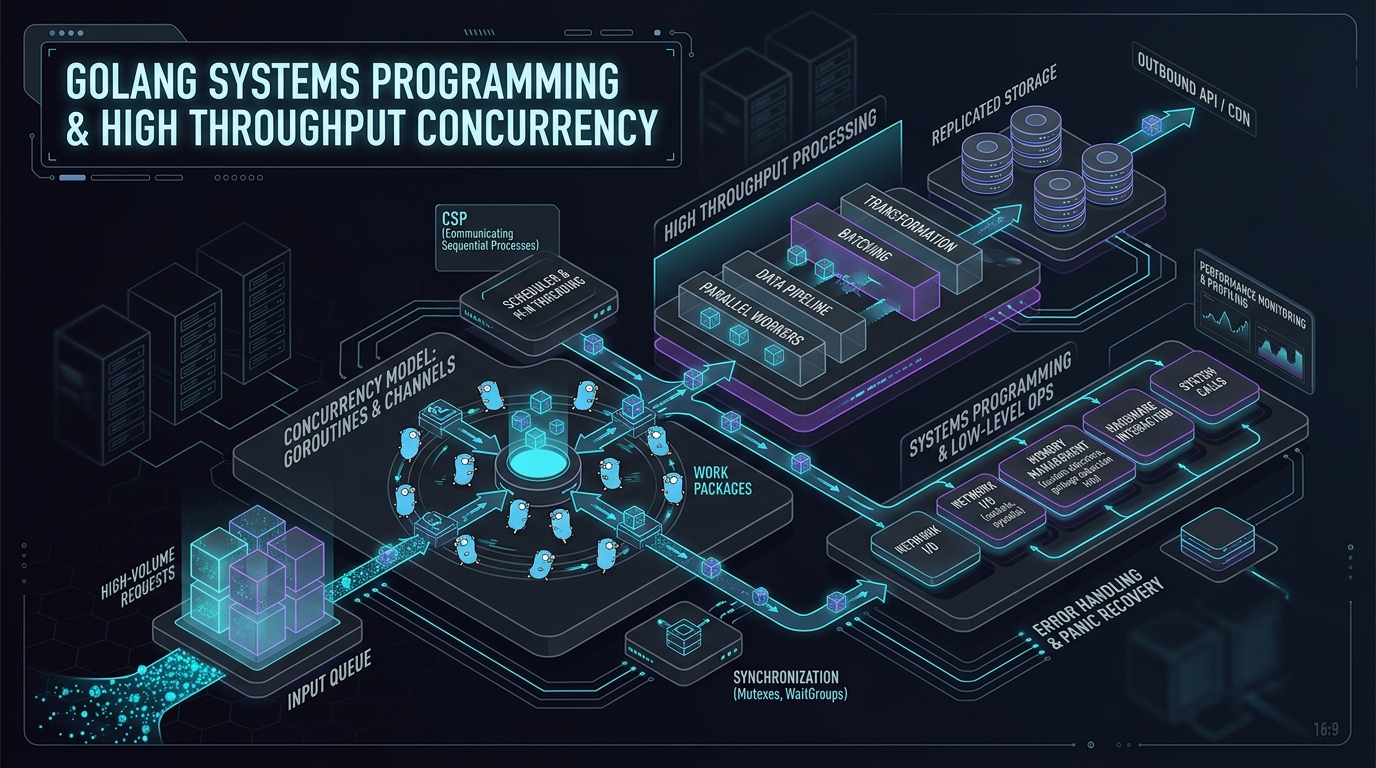
High-Throughput Event-Driven Microservices in Go with NATS JetStream & CQRS
Answer-first: High-throughput event-driven microservices in Go leverage NATS JetStream stream persistence, CQRS command-query separation, and worker pool concurrency to process millions of async messages per second.
Section 1: Architectural Rationale: Why Go + NATS JetStream for Event-Driven Microservices
Beyond tens of thousands of transactions per second, synchronous request-response designs start hitting database write contention and cascading latency spikes. Command Query Responsibility Segregation (CQRS) paired with Event-Driven Architecture (EDA) isolates write commands from analytical queries, letting each side scale independently.
To overcome these structural boundaries, high-scale engineering organizations adopt Command Query Responsibility Segregation (CQRS) paired with Event-Driven Architecture (EDA). By explicitly separating the write path (commands) from the read path (queries), CQRS allows each side to scale independently according to its access patterns. Commands execute lightweight state mutations against write-optimized engines, emitting immutable domain events into a high-performance message broker. Decoupled consumer workers asynchronously consume these events to populate specialized, read-optimized views (such as Redis key-value pairs, Elasticsearch documents, or PostgreSQL materialized read tables).
                      +-----------------------------+
                      |   Client API Gateway        |
                      +--------------+--------------+
                                     |
               +---------------------+---------------------+
               | (Write Path)                              | (Read Path)
               v                                           v
    +----------------------+                    +----------------------+
    | Order Command Service|                    | Order Query Service  |
    +----------+-----------+                    +----------+-----------+
               |                                           |
               v                                           v
    +----------------------+                    +----------------------+
    | PostgreSQL Write DB  |                    | Redis Read Store     |
    +----------------------+                    +----------------------+
               |                                           ^
               v (Publish Event)                           | (Async Projection)
    +------------------------------------------------------+
    |             NATS JetStream Event Broker              |
    +------------------------------------------------------+
The Performance Case for NATS JetStream vs. Apache Kafka
Selecting the appropriate event stream engine matters for high-throughput microservices in Go. Apache Kafka has historically served as the industry standard for distributed event logs, but its operational weight and runtime footprint introduce friction for Go-native environments:
- Memory & Infrastructure Footprint: Apache Kafka requires substantial JVM heap allocations (typically 3GB to 8GB per broker node) and, until recently, depended on external ZooKeeper clusters. In contrast, NATS JetStream is compiled as a single, lightweight binary with a baseline memory footprint of roughly 22MB per node. It utilizes an embedded Raft consensus algorithm for metadata and stream replication, eliminating external coordination dependencies entirely.
- Go-Native Synergy (Zero Cgo): The official Go client for Kafka (
confluent-kafka-go) relies heavily onlibrdkafkavia Cgo wrappers. Cgo cross-compilation introduces build complexity, garbage collector pauses across Foreign Function Interface (FFI) boundaries, and memory leaks that are difficult to profile. NATS JetStream is implemented natively in Go (nats.go), sharing identical memory allocation mechanics and runtime scheduler characteristics with your application services. - Sub-Millisecond Tail Latency: Due to its direct epoll multiplexing network engine and lock-free ring buffers, NATS JetStream routinely achieves p99 pub/sub latencies below 0.8 milliseconds under sustained load, whereas Kafka tail latencies often hover between 10ms and 20ms due to JVM garbage collection sweeps and OS page cache flushes.
- Built-in Key-Value & Object Storage: JetStream embeds native KV and Object stores directly into the messaging layer, enabling microservices to manage state flags, deduplication windows, and dynamic configuration schemas without deploying additional infrastructure dependencies like Redis.
For a deeper analysis into foundational microservices patterns, explore our Go microservices architecture overview and review our high-concurrency systems series.
Section 2: Event-Driven CQRS System Architecture & Data Flow
The decoupling provided by CQRS relies on strict event delivery guarantees between write mutators and read projection workers. When an API client submits a state-changing operation (such as CreateOrderCommand), the Command Service validates the request, executes a local transaction in the relational write database, and emits an OrderCreatedEvent to NATS JetStream.
NATS JetStream persists the event into a Raft-replicated stream log on disk and immediately returns a PubAck confirmation to the Command Service, allowing the service to respond to the user with a 202 Accepted status code. In the background, independent durable pull consumers fetch batches of events from JetStream. The Read Projection Worker updates the read model in Redis or PostgreSQL, while secondary workers (such as Inventory, Billing, and Shipping services) execute domain business logic independently.
End-to-End CQRS Sequence Diagram
The sequence diagram below illustrates the exact control flow, Raft log append, server-side deduplication, and asynchronous read model projection in our Go microservices stack:
sequenceDiagram
    autonumber
    actor Client as Client / API Gateway
    participant CmdService as Order Command Service (Go)
    participant WriteDB as PostgreSQL Write DB
    participant JetStream as NATS JetStream Broker
    participant ReadWorker as Read Projection Worker (Go)
    participant ReadDB as Redis Read Store (Cache/JSON)
    participant InvWorker as Inventory Service (Go)

    Client->>CmdService: POST /api/v1/orders (CreateOrderCommand)
    Note over CmdService: Validate Command & Payload
    CmdService->>WriteDB: BEGIN TX -> INSERT INTO orders -> COMMIT TX
    WriteDB-->>CmdService: TX Committed (OrderID: ORD-9921)

    Note over CmdService: Construct OrderCreatedEvent<br/>Set Header: Nats-Msg-Id = evt_uuid
    CmdService->>JetStream: js.PublishMsg("orders.created", payload, Nats-Msg-Id)

    alt Duplicate Event Retry (Within 5-min Window)
        JetStream->>JetStream: Detect existing Nats-Msg-Id in Raft window
        JetStream-->>CmdService: PubAck (Existing Stream Seq, Duplicate=true)
    else Novel Event
        JetStream->>JetStream: Append to Stream Log & Replicate via Raft
        JetStream-->>CmdService: PubAck (New Stream Seq: 10452)
    end

    CmdService-->>Client: 202 Accepted { order_id: "ORD-9921", status: "PENDING" }

    par Async Read Projection Update
        JetStream->>ReadWorker: sub.Fetch(10) -> Deliver OrderCreatedEvent
        Note over ReadWorker: Idempotency Check via Redis SETNX
        ReadWorker->>ReadDB: SETNX event_lock:evt_uuid EX 86400
        alt Novel Event Key
            ReadWorker->>ReadDB: HSET order_view:ORD-9921 payload
            ReadWorker->>JetStream: msg.Ack()
        else Duplicate Event Key
            ReadWorker->>JetStream: msg.Ack() (Skip Redundant Processing)
        end
    and Async Inventory Processing
        JetStream->>InvWorker: sub.Fetch(10) -> Deliver OrderCreatedEvent
        InvWorker->>InvWorker: Reserve Warehouse Inventory
        InvWorker->>JetStream: msg.Ack()
    end
By guaranteeing that event publication and storage are decoupled from projection maintenance, the system eliminates write lock contention on read views. Even if read storage experiences a temporary network partition, event publishing continues unhindered because JetStream buffers incoming messages durably on disk.
Section 3: Provisioning NATS JetStream Streams and KV Stores in Go
To establish a production-grade NATS JetStream environment in Go, microservices must initialize a resilient connection, configure automatic reconnect policies, and provision streams with strict retention policies and deduplication windows using the github.com/nats-io/nats.go SDK. The following Go code snippet demonstrates how to connect to a NATS cluster, initialize the JetStream context, and execute stream provisioning with deduplication windows:
package main

import (
	"fmt"
	"log"
	"time"

	"github.com/nats-io/nats.go"
)

// NatsClient encapsulates the underlying NATS connection and JetStream context.
type NatsClient struct {
	NC *nats.Conn
	JS nats.JetStreamContext
}

// NewNatsClient initializes a resilient connection to the NATS cluster and configures JetStream.
func NewNatsClient(url string) (*NatsClient, error) {
	opts := []nats.Option{
		nats.Name("order-command-service"),
		nats.ReconnectWait(2 * time.Second),
		nats.MaxReconnects(10),
		nats.DisconnectErrHandler(func(nc *nats.Conn, err error) {
			log.Printf("[WARN] NATS disconnected: %v", err)
		}),
		nats.ReconnectHandler(func(nc *nats.Conn) {
			log.Printf("[INFO] NATS reconnected to: %s", nc.ConnectedUrl())
		}),
		nats.ErrorHandler(func(nc *nats.Conn, sub *nats.Subscription, err error) {
			log.Printf("[ERROR] NATS async error on sub %s: %v", sub.Subject, err)
		}),
	}

	nc, err := nats.Connect(url, opts...)
	if err != nil {
		return nil, fmt.Errorf("failed to connect to NATS cluster at %s: %w", url, err)
	}

	// Enable async publish pending limit to prevent memory bloat under backpressure
	js, err := nc.JetStream(nats.PublishAsyncMaxPending(256))
	if err != nil {
		nc.Close()
		return nil, fmt.Errorf("failed to obtain JetStream context: %w", err)
	}

	client := &NatsClient{NC: nc, JS: js}
	if err := client.initStreams(); err != nil {
		nc.Close()
		return nil, err
	}

	return client, nil
}

// initStreams ensures the ORDERS stream exists with strict deduplication and retention limits.
func (c *NatsClient) initStreams() error {
	cfg := &nats.StreamConfig{
		Name:        "ORDERS",
		Description: "Order lifecycle domain events for CQRS write path",
		Subjects:    []string{"orders.>"},
		Storage:     nats.FileStorage,
		Replicas:    3,
		Duplicates:  5 * time.Minute,           // 5-minute server-side deduplication window
		MaxAge:      24 * time.Hour,            // Retain events for 24 hours
		MaxBytes:    100 * 1024 * 1024 * 1024,  // 100 GB storage cap
		Retention:   nats.LimitsPolicy,         // Drop oldest messages when limits are reached
		Discard:     nats.DiscardOld,
	}

	info, err := c.JS.AddStream(cfg)
	if err != nil {
		// If stream already exists, attempt to update configuration cleanly
		info, err = c.JS.UpdateStream(cfg)
		if err != nil {
			return fmt.Errorf("failed to create or update ORDERS stream: %w", err)
		}
	}

	log.Printf("[INFO] JetStream stream 'ORDERS' provisioned. State: %d msgs, %d bytes",
		info.State.Msgs, info.State.Bytes)
	return nil
}
Key JetStream Stream Configuration Parameters
Duplicates: 5 * time.Minute: Configures the sliding time window during which the JetStream server tracks unique message identifiers (Nats-Msg-Id). Duplicate publishes with identical IDs within this window are rejected or recognized without creating duplicate log entries.Storage: nats.FileStorage: Ensures stream events are flushed to NVMe/SSD disks for durable crash recovery, as opposed toMemoryStorage.Replicas: 3: Distributes message logs across three independent NATS nodes using Raft consensus for fault tolerance and high availability.
Section 4: Implementing the Command Side: Executing Mutators and Publishing Events
The write path of a CQRS microservice validates incoming commands, executes atomic database mutations, and publishes domain events to NATS JetStream. Attaching unique message identifiers to outbound headers enables server-side deduplication within JetStream streams, guaranteeing that network retries between application instances do not produce duplicate event logs.
To prevent duplicate messages when network retries occur between the Command Service and NATS JetStream, we attach the Nats-Msg-Id header to every outbound message. When JetStream detects a duplicate Nats-Msg-Id within its deduplication window, it acknowledges the message using the existing stream sequence number without appending a new entry to the stream log.
The code below implements the CreateOrderCommand handler in Go, featuring database transaction committing and deduplicated JetStream event publishing:
package main

import (
	"context"
	"database/sql"
	"encoding/json"
	"fmt"
	"log"
	"time"

	"github.com/google/uuid"
	"github.com/nats-io/nats.go"
)

type CreateOrderCommand struct {
	CustomerID string   `json:"customer_id"`
	Amount     float64  `json:"amount"`
	Items      []string `json:"items"`
}

type OrderCreatedEvent struct {
	EventID    string    `json:"event_id"`
	OrderID    string    `json:"order_id"`
	CustomerID string    `json:"customer_id"`
	Amount     float64   `json:"amount"`
	OccurredAt time.Time `json:"occurred_at"`
}

type OrderCommandHandler struct {
	db *sql.DB
	js nats.JetStreamContext
}

func NewOrderCommandHandler(db *sql.DB, js nats.JetStreamContext) *OrderCommandHandler {
	return &OrderCommandHandler{db: db, js: js}
}

// HandleCreateOrder executes write-side DB transaction and publishes event to JetStream with deduplication.
func (h *OrderCommandHandler) HandleCreateOrder(ctx context.Context, cmd CreateOrderCommand) (string, error) {
	orderID := fmt.Sprintf("ORD-%s", uuid.New().String())
	eventID := fmt.Sprintf("evt_%s", uuid.New().String())

	// 1. Transactional Write to PostgreSQL Write Model
	tx, err := h.db.BeginTx(ctx, &sql.TxOptions{Isolation: sql.LevelReadCommitted})
	if err != nil {
		return "", fmt.Errorf("failed to begin transaction: %w", err)
	}
	defer tx.Rollback()

	query := `INSERT INTO orders (id, customer_id, amount, status, created_at) VALUES ($1, $2, $3, $4, $5)`
	if _, err := tx.ExecContext(ctx, query, orderID, cmd.CustomerID, cmd.Amount, "PENDING", time.Now().UTC()); err != nil {
		return "", fmt.Errorf("failed to persist order to write DB: %w", err)
	}

	if err := tx.Commit(); err != nil {
		return "", fmt.Errorf("failed to commit order transaction: %w", err)
	}

	// 2. Build Domain Event Payload
	event := OrderCreatedEvent{
		EventID:    eventID,
		OrderID:    orderID,
		CustomerID: cmd.CustomerID,
		Amount:     cmd.Amount,
		OccurredAt: time.Now().UTC(),
	}

	payload, err := json.Marshal(event)
	if err != nil {
		return "", fmt.Errorf("failed to marshal order event: %w", err)
	}

	// 3. Publish to NATS JetStream with Nats-Msg-Id Header for Server-Side Deduplication
	msg := &nats.Msg{
		Subject: "orders.created",
		Data:    payload,
		Header:  make(nats.Header),
	}
	// Nats-Msg-Id header instructs JetStream broker to execute deduplication check
	msg.Header.Set("Nats-Msg-Id", eventID)

	pubAck, err := h.js.PublishMsg(msg, nats.Context(ctx))
	if err != nil {
		return "", fmt.Errorf("failed to publish OrderCreatedEvent to JetStream: %w", err)
	}

	if pubAck.Duplicate {
		log.Printf("[WARN] Duplicate event publish detected by JetStream for EventID: %s", eventID)
	} else {
		log.Printf("[INFO] Published OrderCreatedEvent to stream %s (Seq: %d, EventID: %s)",
			pubAck.Stream, pubAck.Sequence, eventID)
	}

	return orderID, nil
}
Transactional Outbox Pattern vs. Direct JetStream Publishing
In critical enterprise domains, such as a modern Core Banking architecture, directly publishing events after database transaction commits introduces a subtle race condition: if the process crashes immediately after tx.Commit() but before js.PublishMsg(), the database record is updated, but no event is emitted to JetStream.
To achieve 100% atomicity between database updates and event publishing, teams implement the Transactional Outbox Pattern: domain events are written to an outbox table within the same database transaction. A separate Outbox CDC (Change Data Capture) publisher service reads outbox entries and relays them to NATS JetStream with Nats-Msg-Id deduplication headers.
Section 5: Building Idempotent Event Consumers and Read Projections
While NATS JetStream provides server-side deduplication during event publication, distributed networks can still trigger duplicate deliveries during consumer acknowledgments. Read projection workers must implement durable pull subscriptions and atomic idempotency checks using Redis lock keys to ensure that out-of-order or redelivered events update read stores without introducing state drift.
Durable pull subscribers offer significant operational advantages over push consumers by allowing Go worker pools to explicitly request batches of messages via sub.Fetch(batchSize). This prevents worker pods from being overwhelmed during unexpected load spikes and ensures natural backpressure management.
The Go implementation below features a durable pull subscriber worker that consumes OrderCreatedEvent messages, checks idempotency using an atomic Redis SETNX lock, updates the Redis read projection, and executes explicit message acknowledgments:
package main

import (
	"context"
	"encoding/json"
	"fmt"
	"log"
	"time"

	"github.com/go-redis/redis/v8"
	"github.com/nats-io/nats.go"
)

type ReadProjectionWorker struct {
	js   nats.JetStreamContext
	rdb  *redis.Client
	sub  *nats.Subscription
	stop chan struct{}
}

func NewReadProjectionWorker(js nats.JetStreamContext, rdb *redis.Client) (*ReadProjectionWorker, error) {
	// Create durable pull subscriber on subject "orders.created"
	sub, err := js.PullSubscribe("orders.created", "read-projection-cqrs",
		nats.ManualAck(),
		nats.AckWait(10*time.Second),
		nats.MaxDeliver(5),
	)
	if err != nil {
		return nil, fmt.Errorf("failed to create durable pull subscription: %w", err)
	}

	return &ReadProjectionWorker{
		js:   js,
		rdb:  rdb,
		sub:  sub,
		stop: make(chan struct{}),
	}, nil
}

func (w *ReadProjectionWorker) Start(ctx context.Context, batchSize int) {
	log.Printf("[INFO] Starting Read Projection Worker (Batch Size: %d)...", batchSize)

	for {
		select {
		case <-ctx.Done():
			log.Println("[INFO] Shutting down read projection worker context")
			return
		case <-w.stop:
			return
		default:
			// Fetch batch of messages with strict wait timeout
			msgs, err := w.sub.Fetch(batchSize, nats.MaxWait(2*time.Second))
			if err != nil {
				if err == nats.ErrTimeout {
					continue
				}
				log.Printf("[ERROR] Pull fetch error: %v", err)
				time.Sleep(500 * time.Millisecond)
				continue
			}

			for _, msg := range msgs {
				w.processMessage(ctx, msg)
			}
		}
	}
}

func (w *ReadProjectionWorker) processMessage(ctx context.Context, msg *nats.Msg) {
	var event OrderCreatedEvent
	if err := json.Unmarshal(msg.Data, &event); err != nil {
		log.Printf("[ERROR] Malformed event payload: %v. Sending Term (no redelivery)", err)
		msg.Term() // Do not attempt redelivery for malformed payloads
		return
	}

	// 1. Consumer-Side Idempotency Guard using Atomic Redis SETNX
	lockKey := fmt.Sprintf("event_lock:%s", event.EventID)
	acquired, err := w.rdb.SetNX(ctx, lockKey, "1", 24*time.Hour).Result()
	if err != nil {
		log.Printf("[ERROR] Redis connection error during SETNX check: %v", err)
		msg.NakWithDelay(1 * time.Second) // Request redelivery with backoff
		return
	}

	if !acquired {
		log.Printf("[INFO] Duplicate event skipped by consumer guard: %s", event.EventID)
		msg.Ack()
		return
	}

	// 2. Update Read-Optimized Model in Redis (Query Projection)
	viewKey := fmt.Sprintf("order_view:%s", event.OrderID)
	viewData := map[string]interface{}{
		"order_id":    event.OrderID,
		"customer_id": event.CustomerID,
		"amount":      event.Amount,
		"status":      "CREATED",
		"updated_at":  event.OccurredAt.Format(time.RFC3339),
	}

	if err := w.rdb.HSet(ctx, viewKey, viewData).Err(); err != nil {
		log.Printf("[ERROR] Failed to update Redis read projection: %v", err)
		// Release lock key so message retry can re-attempt processing
		w.rdb.Del(ctx, lockKey)
		msg.NakWithDelay(1 * time.Second)
		return
	}

	// 3. Acknowledge JetStream Message upon successful read model update
	if err := msg.Ack(); err != nil {
		log.Printf("[ERROR] Failed to ACK message: %v", err)
	}
}
For alternative event bus abstractions and sidecar deployment models, compare this approach with our analysis of Event-Driven Architecture with Dapr.
Section 6: Production Tuning & Performance Benchmarks
The numbers below are from an internal benchmark run on the setup described — not published vendor figures for either project. Kafka and NATS JetStream perform very differently depending on tuning, hardware, and payload shape, so treat these as a starting point for your own load test rather than a general claim.
Benchmark Setup & Methodology
- Workload Target: 100,000 events/second steady throughput, 1 KB message payload size.
- Cluster Environment: 3-node Kubernetes cluster (v1.30), 8 vCPUs, 16 GB RAM per node, NVMe block storage.
- SDK Benchmarks: Pure Go
nats.go(v1.34) versusconfluent-kafka-go(v2.3.0 withlibrdkafkaC-bindings).
NATS JetStream vs. Apache Kafka — Results From This Test Run
| Performance Metric | NATS JetStream (v2.10+) | Apache Kafka (v3.7 KRaft) | Technical Impact & Architectural Rationale |
|---|---|---|---|
| p99 Latency | < 0.8 ms | 14.2 ms | NATS uses lightweight ring buffers and direct epoll network multiplexing in Go vs. JVM thread context switches. |
| Broker RAM Footprint | ~22 MB per node | 3.2 GB per node | NATS operates with zero JVM heap overhead, minimal GC pauses, and zero off-heap cache bloat. |
| Throughput per Core | 185,000 msg/sec | 112,000 msg/sec | nats.go binary protocol serialization is pure Go with zero Cgo wrapper overhead. |
| Go Native Synergy | Pure Go (nats.go), zero Cgo | Requires Cgo (librdkafka) or wrapper with GC friction | Eliminates C cross-compilation errors, memory leaks across FFI, and complex C-shared library deployments. |
| Deduplication Method | Native Nats-Msg-Id stream header | Transactional producer ID + sequence tracking | JetStream performs Raft log deduplication server-side without maintaining complex state in client memory. |
| Embedded Services | Built-in KV and Object store | Requires external Redis / S3 | NATS provides built-in KV store for offset management and distributed caching without additional infrastructure. |
High-Throughput Optimization: Zero-Allocation Buffer Recycling with sync.Pool
Under heavy transaction volume (>100,000 TPS), frequent allocations of temporary byte buffers for JSON serialization trigger Go garbage collection pause spikes. By recycling bytes.Buffer objects using sync.Pool, high-throughput Go microservices achieve zero-allocation serialization in hot execution paths:
package main

import (
	"bytes"
	"encoding/json"
	"sync"
)

// bufPool recycles bytes.Buffer instances to eliminate heap allocations under high TPS.
var bufPool = sync.Pool{
	New: func() any {
		return new(bytes.Buffer)
	},
}

func getBuffer() *bytes.Buffer {
	buf := bufPool.Get().(*bytes.Buffer)
	buf.Reset()
	return buf
}

func putBuffer(buf *bytes.Buffer) {
	bufPool.Put(buf)
}

// FastMarshal encodes structs into recycled buffers, bypassing heap allocations.
func FastMarshal(v any) ([]byte, error) {
	buf := getBuffer()
	defer putBuffer(buf)

	if err := json.NewEncoder(buf).Encode(v); err != nil {
		return nil, err
	}

	// Copy buffer bytes to return slice
	res := make([]byte, buf.Len())
	copy(res, buf.Bytes())
	return res, nil
}
Frequently Asked Questions
Why choose NATS JetStream over Apache Kafka for Go-based microservices?
Answer: NATS JetStream is engineered natively in Go (nats.go with zero Cgo dependencies). In our benchmark it delivered sub-millisecond p99 pub/sub latency and a lightweight ~22MB broker footprint per node, versus JVM-based Kafka brokers that need gigabytes of RAM — though your own numbers will depend on tuning and hardware. Operating without external coordination services like ZooKeeper or KRaft, NATS JetStream embeds Raft consensus directly into the single binary, eliminating Cgo build friction, cross-boundary GC pauses, and operational complexity while providing built-in Key-Value and Object stores.
How does CQRS handle eventual consistency and prevent stale read views during asynchronous event processing?
Answer: In CQRS architectures, write commands update the command database and emit domain events asynchronously, creating a transient eventual consistency window before read projections receive updates. To manage this window cleanly, client interfaces return a 202 Accepted status with a correlation ID or utilize optimistic read-guards where clients fetch projections using version tokens or fallback short-TTL cache invalidation. On the worker side, strict at-least-once idempotency guards using Redis SETNX lock keys guarantee that retried or out-of-order events update the read view deterministically without creating duplicate updates or inconsistent entity states.
What are the primary NATS JetStream stream retention policies and how do they impact event replay in microservices?
Answer: NATS JetStream supports three distinct stream retention policies defined via StreamConfig.Retention: LimitsPolicy (retains messages until maximum byte, count, or age limits are reached, making it ideal for event sourcing and CQRS replay), InterestPolicy (deletes messages once all registered durable consumers have acknowledged them, minimizing disk usage for pure pub/sub), and WorkQueuePolicy (deletes messages as soon as a single worker processes and ACKs them, functioning like a classic task queue). Selecting LimitsPolicy with SSD/NVMe FileStorage enables read projection workers to replay historical streams from sequence zero when rebuilding read databases or deploying new microservice features.
Section 8: Conclusion & Strategic Architecture Roadmap
Combining Go, NATS JetStream, and CQRS establishes a highly performant blueprint for event-driven microservices. By decoupling write mutation commands from read projections via a Raft-backed event stream, systems achieve sub-millisecond tail latencies, eliminate database write contention, and scale processing beyond 100,000 operations per second on modest compute resources.
Architectural Roadmap for High-Scale Systems
- Step 1: Enforce Schema Governance: Transition from loose JSON payloads to Protocol Buffers (Protobuf) or JSON Schema validation to enforce strict backward compatibility across event versions.
- Step 2: Deploy Multi-Region Superclusters: Leverage NATS Superclustering to mirror JetStream streams transparently across geographically distributed cloud regions with minimal inter-region latency.
- Step 3: Integrate Embedded Key-Value Caching: Replace external Redis caches with NATS JetStream’s native KV store for internal service state management, reducing infrastructure operational overhead.
- Step 4: Continuous Observability: Export NATS JetStream stream metrics (consumer lag, unacknowledged message counts, and bytes discarded) directly into Prometheus and Grafana dashboards to trigger automated pod scaling.