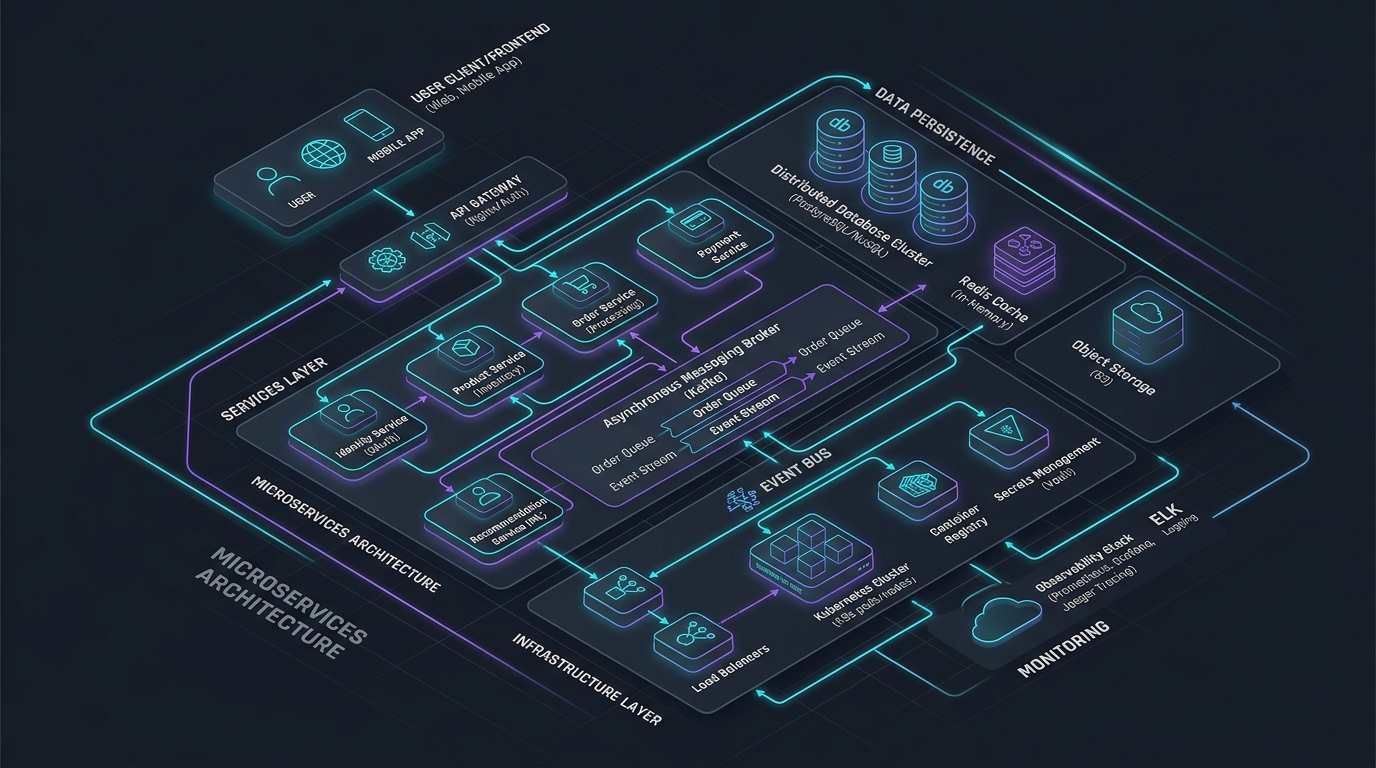
21-Service Go Ecommerce Microservices Diagram
E-Commerce Architecture Patterns: Monolith vs Microservices
Answer-first: An ecommerce microservices architecture diagram structures enterprise retail platforms into 6 bounded domains—Commerce Flow, Product & Content, Logistics, Post-Purchase, Identity & Access, and Platform Operations—powering 21 Go microservices. Orchestrated via gRPC contracts and Dapr Pub/Sub event meshes, this design delivers sub-50ms P99 latency, isolates database-per-service failures, and automates rollbacks via distributed Saga workflows.
Prerequisite: Familiarity with Domain-Driven Design (DDD), gRPC service contracts, Dapr event mesh Pub/Sub, and distributed Saga patterns in Go.
Monolithic vs Microservices E-Commerce Comparison
| Dimension | Monolithic E-Commerce | Microservices E-Commerce |
|---|---|---|
| Scaling | Vertical scaling of entire monolith application | Independent horizontal scaling per domain (e.g., Catalog 10x Cart) |
| Database Architecture | Single shared database with cross-table SQL joins | Database-per-service (PostgreSQL, Redis, Elasticsearch) with zero cross-domain access |
| Deployment Frequency | Low frequency; all-or-nothing monolithic releases | High frequency; independent CI/CD pipelines per microservice |
| Fault Tolerance | Low; a single bug or memory leak crashes the entire store | High; failure in one domain (e.g., Reviews) does not block Checkout |
| Complexity | Low initial architectural and operational complexity | High distributed complexity (Saga pattern, gRPC contracts, Dapr mesh) |
| Operational Cost | Lower initial cost; scales expensively at high traffic | Higher initial infrastructure setup; cost-effective at high scale |
- Practical latency and memory metrics comparing an Envoy-based API Gateway to a custom Go reverse proxy under 100k concurrent connections.
- How to tune circuit breaker thresholds (
go-resiliency/breaker) to prevent premature service isolation during temporary network jitters.
When transitioning from a monolithic platform to a distributed microservice setup, the hardest question isn’t “How do we write the code?” — it’s “How do these moving parts talk to each other safely, and why is each boundary drawn exactly where it is?”
This post is the primary architectural anchor for our composable commerce series. It presents the complete 21-service system blueprint and domain boundaries. For a practical step-by-step decoupling guide, see our sister article on Composable E-Commerce Migration.
Microservices Ecommerce Architecture: The 6 Core Business Domains
Before drawing a single line in a diagram, we bounded the ecosystem around Domain-Driven Design (DDD) principles. Every domain owns its own Postgres database. No cross-domain queries. Communication is exclusively through events or explicit gRPC contracts.
The 6 domains and their 21 services:
| Domain | Services | Owns |
|---|---|---|
| Commerce Flow | Checkout, Order, Payment | The money path — highest criticality |
| Product & Content | Catalog, Pricing, Promotion, Search | Read-heavy, sub-50ms latency |
| Logistics | Warehouse, Fulfillment, Shipping | Physical world integration |
| Post-Purchase | Returns, Loyalty | Customer retention after delivery |
| Identity & Access | Auth, User, Customer | Security boundary between internal staff and external customers |
| Platform Operations | Gateway, Analytics, Notification | Shared infrastructure utilities |
The reasoning behind separating User from Customer is worth stating explicitly: internal employees and external buyers have fundamentally different access patterns, data structures, and compliance requirements. Merging them creates a schema that serves neither well and creates a security surface where an internal RBAC bug could expose customer PII.
For the full breakdown of each service’s responsibilities, see Deconstructing the Ecosystem: Service Details by Domain.
2.1 21 Microservices Port, Protocol & Data Store Contract Matrix
The following matrix defines the authoritative communication contracts, network endpoints, and data ownership across all 21 microservices:
| Service Name | Bounded Domain | Ingress Port | Protocol | Primary Data Store | Pub/Sub Topic Emitted |
|---|---|---|---|---|---|
| API Gateway | Platform Operations | :8080 / :8443 | HTTPS / gRPC | Redis (Rate Limiting) | audit.traffic.ingress |
| Auth Service | Identity & Access | :50051 | gRPC / HTTP | PostgreSQL | auth.token.revoked |
| User Service | Identity & Access | :50052 | gRPC | PostgreSQL | user.profile.updated |
| Customer Profile | Identity & Access | :50053 | gRPC | MongoDB | customer.tier.changed |
| Catalog (PIM) | Product & Content | :50054 | gRPC | PostgreSQL | catalog.product.published |
| Pricing Service | Product & Content | :50055 | gRPC | Redis + PostgreSQL | pricing.rule.updated |
| Promotions | Product & Content | :50056 | gRPC | PostgreSQL | promo.coupon.applied |
| Search Service | Product & Content | :50057 | gRPC / HTTP | Elasticsearch / Qdrant | search.index.synced |
| Cart Service | Commerce Flow | :50058 | gRPC | Redis (Cluster) | cart.item.added |
| Checkout Orchestrator | Commerce Flow | :50059 | gRPC | Redis (Dapr State) | checkout.saga.started |
| Order Service | Commerce Flow | :50060 | gRPC | PostgreSQL (Outbox) | order.created, order.paid |
| Payment Service | Commerce Flow | :50061 | gRPC | PostgreSQL (Encrypted) | payment.authorized, payment.failed |
| Warehouse (WMS) | Logistics | :50062 | gRPC | PostgreSQL | stock.reserved, stock.depleted |
| Fulfillment | Logistics | :50063 | gRPC | PostgreSQL | fulfillment.dispatched |
| Shipping Hub | Logistics | :50064 | gRPC | PostgreSQL | shipping.carrier.booked |
| Returns (RMA) | Post-Purchase | :50065 | gRPC | PostgreSQL | return.approved, refund.queued |
| Loyalty & Points | Post-Purchase | :50066 | gRPC | PostgreSQL | loyalty.points.accrued |
| Customer Support | Post-Purchase | :50067 | gRPC | PostgreSQL | ticket.escalated |
| Analytics Engine | Platform Operations | :50068 | gRPC / Kafka | ClickHouse | analytics.metric.aggregated |
| Notification Hub | Platform Operations | :50069 | gRPC | Redis | notification.sent |
| Configuration Hub | Platform Operations | :50070 | gRPC | etcd | config.cluster.reloaded |
The High-Level Architecture
The system architecture diagram below illustrates the 21-service e-commerce ecosystem across its 6 core business domains. It details the synchronous HTTP/gRPC ingress boundaries and the asynchronous Dapr Pub/Sub event mesh connecting downstream logistics and analytics services:
graph TD
    subgraph "🌐 External Clients"
        FE["Customer Website (Next.js)"]
        ADMIN["Admin Dashboard (React)"]
    end

    subgraph "🚪 API Gateway Layer"
        GW["Global Gateway\n(Auth · Rate Limit · Circuit Breaker · BFF)"]
    end

    subgraph "🔐 Identity & Access"
        AUTH["Auth Service\n(RS256 JWT · OAuth2 · MFA)"]
        USR["User Service\n(Internal RBAC)"]
        CUST["Customer Profile\n(LTV · Segmentation)"]
    end

    subgraph "📦 Product & Content"
        CAT["Catalog (PIM)\n(EAV → Normalized)"]
        PRC["Pricing Rules\n(Multi-currency · Tax)"]
        PROMO["Promotions\n(BOGO · Coupons)"]
        SEARCH["Search (CQRS)\n(Elasticsearch)"]
    end

    subgraph "🛒 Commerce Engine"
        CK["Checkout Orchestrator\n(Saga initiator)"]
        ORD["Order Lifecycle\n(8-state FSM)"]
        PAY["Payment Gateway\n(Stripe · VNPay · MoMo)"]
    end

    subgraph "🚚 Logistics & Fulfillment"
        WH["Warehouse (WMS)\n(OCC · Idempotency)"]
        FF["Fulfillment\n(Pick · Pack · Hand-off)"]
        SH["Shipping Hub\n(Carrier normalization)"]
    end

    subgraph "🎁 Post-Purchase"
        RET["Returns (RMA)\n(Restock · Refund gRPC)"]
        LR["Loyalty & Rewards\n(Outbox · Point ledger)"]
    end

    subgraph "📡 Platform Services"
        AN["Analytics Engine\n(Passive observer)"]
        NOTIF["Notification Hub\n(SendGrid · Twilio)"]
    end

    %% External traffic
    FE & ADMIN --> GW

    %% Synchronous paths (solid)
    GW --> AUTH & CUST & CAT & SEARCH & CK & ORD

    %% gRPC internal calls (dotted)
    CK -.->|"gRPC: CreateOrder"| ORD
    CK -.->|"gRPC: Authorize"| PAY
    RET -.->|"gRPC: Refund"| PAY

    %% Async event paths (double)
    ORD ==>|"order.confirmed"| WH
    ORD ==>|"order.paid"| FF
    FF ==>|"fulfillment.completed"| SH
    SH ==>|"shipping.delivered"| ORD
    ORD ==>|"order.cancelled"| LR & PROMO
    CAT ==>|"product.updated"| SEARCH & AN
    ORD ==>|"order.created"| AN & CUST & NOTIF
Solid lines = synchronous HTTP/gRPC. Double lines (==>) = asynchronous events via Dapr PubSub.
Traffic Anatomy: Three Distinct Flows
Production traffic splits into three execution paths: synchronous HTTP/gRPC for low-latency reads, Saga-orchestrated transactions for checkout writes, and asynchronous event streams for post-purchase fulfillment.
Flow 1 — The Gateway Shield (Read Path)
All external traffic enters through the API Gateway. The Gateway enforces:
- JWT validation — offloaded from downstream services; every request is authenticated at the edge
- Rate limiting — IP-based and user-based, protecting against scraping and checkout abuse
- Circuit breaking — if the Catalog service is degraded, the Gateway fails fast rather than stacking requests
Read-heavy operations (product listing, search, user profile) resolve here with sub-50ms latency because the Search service maintains a pre-indexed Elasticsearch CQRS read model, updated in near real-time via events from Catalog and Pricing.
Flow 2 — The Checkout Saga (Write Path)
The Checkout Saga coordinates gRPC reservations with Warehouse, Payment, and Order services. In 2026, raw Pub/Sub choreographies are heavily replaced by Dapr Workflows (a centralized Orchestrator) to guarantee fault-tolerant Distributed Transactions and automated rollbacks before publishing asynchronous events:
sequenceDiagram
    participant GW as API Gateway
    participant CK as Checkout
    participant WH as Warehouse
    participant PAY as Payment
    participant ORD as Order
    participant DAPR as Dapr PubSub

    GW->>CK: POST /checkout/confirm
    CK->>WH: gRPC: ReserveStock (TTL 15min)
    WH-->>CK: ✅ Reserved

    CK->>PAY: gRPC: Authorize payment
    PAY-->>CK: ✅ Authorized

    CK->>ORD: gRPC: CreateOrder
    ORD-->>CK: ✅ Order #10482 created

    ORD->>DAPR: Publish order.confirmed
    Note over DAPR: Async from here — Checkout returns 200 to user

    DAPR-->>WH: Deduct reserved stock permanently
    DAPR-->>CK: Trigger fulfillment workflow
Failure handling uses Compensating Transactions: if the Payment service declines the card after stock is reserved, the Checkout service triggers checkout.failed. The Warehouse service listens for this event and releases the reserved stock. No long-lived database transactions, no connection pool exhaustion under load.
For the complete implementation — including the Optimistic Concurrency Control SQL for inventory race conditions and the idempotency key pattern — see Architecting a 21-Service E-commerce Ecosystem with Golang & DDD.
Flow 3 — The Async Event Mesh (Post-Checkout)
Once order.paid fires into the Dapr event mesh, synchronous execution terminates from the customer’s perspective. Downstream services run in parallel:
- Warehouse decrements permanently reserved stock
- Fulfillment triggers the pick-pack-ship workflow
- Analytics increments revenue dashboards
- Customer updates LTV and purchase history
- Notification fires the order confirmation email/SMS
A failure in any of these services (Notification is unreachable, Analytics is slow) does not affect the customer’s checkout experience or the order record. Isolation is enforced at the infrastructure level — each service owns its own database.
For the Dapr event naming conventions, Dead Letter Queue patterns, and idempotency design, see Mastering Event-Driven Architecture with Dapr Pub/Sub.
Flow 4 — Distributed Tracing & Observability (OpenTelemetry)
Operating 21 microservices is impossible without 100% visibility. Instead of manually injecting tracing code into every Go service, the system relies on the Dapr Sidecar to automatically export W3C Trace Contexts via OpenTelemetry (OTel). Every gRPC call, Pub/Sub event, and database query is automatically traced and exported to Prometheus and Jaeger, ensuring you can identify latency bottlenecks across the mesh without modifying business logic.
The CQRS Pattern for Search
Product search deserves special attention because it solves a problem that Magento’s EAV model struggles with at scale: joining 5+ tables at query time to render a single product listing is too slow.
The architecture flowchart below shows the CQRS read-model synchronization pipeline:
flowchart LR
    CAT["Catalog Service\n(source of truth)"] -- "catalog.product.updated" --> DAPR["Dapr PubSub"]
    PRC["Pricing Service"] -- "pricing.price.updated" --> DAPR
    WH["Warehouse Service"] -- "warehouse.stock.changed" --> DAPR
    DAPR --> SW["Search Worker\n(subscriber)"]
    SW --> ES[("Elasticsearch\nFlat documents")]
    ES -- "sub-50ms reads" --> GW["API Gateway"]
When the Catalog team updates a product, they write to their own Postgres database and publish catalog.product.updated. The Search Worker receives the event and rebuilds the Elasticsearch document for that SKU — merging current price from the Pricing service and current stock from the Warehouse service into a single flat document.
No cron jobs. No full reindex. No stale data windows. Catalog, Pricing, and Warehouse each own their domain data; Search owns the read projection.
Production Implementation: Go API Gateway Reverse Proxy with Circuit Breaker
The following Go 1.25+ implementation demonstrates the edge API Gateway Reverse Proxy routing across the 21 microservices. It combines per-IP Token Bucket Rate Limiting with an active Circuit Breaker to protect downstream services from cascading failure during traffic surges:
// Package main implements a high-performance API Gateway Reverse Proxy for 21 Microservices.
// Uses standard library net/http/httputil paired with Token Bucket and Circuit Breaker patterns.
package main

import (
	"context"
	"errors"
	"log"
	"net"
	"net/http"
	"net/http/httputil"
	"net/url"
	"os"
	"os/signal"
	"sync"
	"syscall"
	"time"

	"golang.org/x/time/rate"
)

// BreakerState defines the current circuit breaker operating condition
type BreakerState int

const (
	StateClosed BreakerState = iota
	StateHalfOpen
	StateOpen
)

// CircuitBreaker manages fault tolerance and prevents cascade failures
type CircuitBreaker struct {
	mu          sync.Mutex
	state       BreakerState
	failures    int
	maxFailures int
	cooldown    time.Duration
	lastFailure time.Time
}

// NewCircuitBreaker initializes a circuit breaker with failure thresholds
func NewCircuitBreaker(maxFailures int, cooldown time.Duration) *CircuitBreaker {
	return &CircuitBreaker{
		state:       StateClosed,
		maxFailures: maxFailures,
		cooldown:    cooldown,
	}
}

// Allow determines if an inbound request may proceed to downstream targets
func (cb *CircuitBreaker) Allow() bool {
	cb.mu.Lock()
	defer cb.mu.Unlock()

	now := time.Now()
	switch cb.state {
	case StateOpen:
		if now.Sub(cb.lastFailure) > cb.cooldown {
			cb.state = StateHalfOpen
			log.Printf("[CIRCUIT BREAKER] Transitioning to Half-Open probe state")
			return true
		}
		return false
	case StateHalfOpen, StateClosed:
		return true
	default:
		return true
	}
}

// RecordResult updates circuit breaker status based on downstream HTTP outcomes
func (cb *CircuitBreaker) RecordResult(success bool) {
	cb.mu.Lock()
	defer cb.mu.Unlock()

	if success {
		if cb.state == StateHalfOpen {
			log.Printf("[CIRCUIT BREAKER] Downstream recovered. Closing circuit (StateClosed)")
		}
		cb.state = StateClosed
		cb.failures = 0
		return
	}

	cb.failures++
	cb.lastFailure = time.Now()
	if cb.failures >= cb.maxFailures {
		cb.state = StateOpen
		log.Printf("[CIRCUIT BREAKER] Exceeded %d consecutive failures! Opening circuit (StateOpen) for %v", cb.failures, cb.cooldown)
	}
}

// IPRateLimiter provides per-client IP token bucket rate limiting
type IPRateLimiter struct {
	mu       sync.Mutex
	limiters map[string]*rate.Limiter
	r        rate.Limit
	b        int
}

// NewIPRateLimiter creates an IP rate limiter
func NewIPRateLimiter(r rate.Limit, b int) *IPRateLimiter {
	return &IPRateLimiter{
		limiters: make(map[string]*rate.Limiter),
		r:        r,
		b:        b,
	}
}

// GetLimiter retrieves or creates a token bucket for a specific IP
func (i *IPRateLimiter) GetLimiter(ip string) *rate.Limiter {
	i.mu.Lock()
	defer i.mu.Unlock()

	limiter, exists := i.limiters[ip]
	if !exists {
		limiter = rate.NewLimiter(i.r, i.b)
		i.limiters[ip] = limiter
	}
	return limiter
}

// GatewayProxy routes inbound traffic to the 21 domain-bounded microservices
type GatewayProxy struct {
	checkoutProxy *httputil.ReverseProxy
	catalogProxy  *httputil.ReverseProxy
	limiter       *IPRateLimiter
	checkoutCB    *CircuitBreaker
}

// NewGatewayProxy initializes reverse proxy transports with pooled connections
func NewGatewayProxy(checkoutURL, catalogURL *url.URL) *GatewayProxy {
	transport := &http.Transport{
		Proxy: http.ProxyFromEnvironment,
		DialContext: (&net.Dialer{
			Timeout:   2 * time.Second,
			KeepAlive: 30 * time.Second,
		}).DialContext,
		MaxIdleConns:        1000,
		MaxIdleConnsPerHost: 200,
		IdleConnTimeout:     90 * time.Second,
		TLSHandshakeTimeout: 3 * time.Second,
	}

	pCheckout := httputil.NewSingleHostReverseProxy(checkoutURL)
	pCheckout.Transport = transport

	pCatalog := httputil.NewSingleHostReverseProxy(catalogURL)
	pCatalog.Transport = transport

	return &GatewayProxy{
		checkoutProxy: pCheckout,
		catalogProxy:  pCatalog,
		limiter:       NewIPRateLimiter(rate.Limit(100), 200), // 100 req/s, burst 200
		checkoutCB:    NewCircuitBreaker(5, 10*time.Second),
	}
}

func extractIP(r *http.Request) string {
	ip := r.Header.Get("X-Forwarded-For")
	if ip != "" {
		return ip
	}
	host, _, err := net.SplitHostPort(r.RemoteAddr)
	if err != nil {
		return r.RemoteAddr
	}
	return host
}

func (gw *GatewayProxy) ServeHTTP(w http.ResponseWriter, r *http.Request) {
	clientIP := extractIP(r)

	// 1. Edge Token Bucket Rate Limiting
	if !gw.limiter.GetLimiter(clientIP).Allow() {
		http.Error(w, `{"error":"RATE_LIMIT_EXCEEDED","message":"Too many requests. Please retry later."}`, http.StatusTooManyRequests)
		return
	}

	// 2. Path-based Routing
	path := r.URL.Path
	switch {
	case len(path) >= 9 && path[:9] == "/checkout":
		// Protect critical Checkout Service via Circuit Breaker
		if !gw.checkoutCB.Allow() {
			w.Header().Set("Content-Type", "application/json")
			w.WriteHeader(http.StatusServiceUnavailable)
			_, _ = w.Write([]byte(`{"error":"CIRCUIT_OPEN","message":"Checkout service temporarily degraded. Retry in 10s."}`))
			return
		}

		recorder := &statusRecorder{ResponseWriter: w, statusCode: http.StatusOK}
		gw.checkoutProxy.ServeHTTP(recorder, r)

		if recorder.statusCode >= 500 {
			gw.checkoutCB.RecordResult(false)
		} else {
			gw.checkoutCB.RecordResult(true)
		}

	case len(path) >= 8 && path[:8] == "/catalog":
		gw.catalogProxy.ServeHTTP(w, r)

	default:
		http.Error(w, `{"error":"NOT_FOUND","message":"API route boundary does not exist."}`, http.StatusNotFound)
	}
}

type statusRecorder struct {
	http.ResponseWriter
	statusCode int
}

func (r *statusRecorder) WriteHeader(code int) {
	r.statusCode = code
	r.ResponseWriter.WriteHeader(code)
}

func main() {
	checkoutURL, _ := url.Parse("http://checkout-service.production.svc.cluster.local:8080")
	catalogURL, _ := url.Parse("http://catalog-service.production.svc.cluster.local:8081")

	gateway := NewGatewayProxy(checkoutURL, catalogURL)

	server := &http.Server{
		Addr:         ":8000",
		Handler:      gateway,
		ReadTimeout:  5 * time.Second,
		WriteTimeout: 10 * time.Second,
		IdleTimeout:  120 * time.Second,
	}

	go func() {
		log.Printf("21-Service Go API Gateway listening on :8000...")
		if err := server.ListenAndServe(); err != nil && !errors.Is(err, http.ErrServerClosed) {
			log.Fatalf("Gateway server failure: %v", err)
		}
	}()

	quit := make(chan os.Signal, 1)
	signal.Notify(quit, syscall.SIGINT, syscall.SIGTERM)
	<-quit
	log.Println("Initiating graceful shutdown for API Gateway...")

	ctx, cancel := context.WithTimeout(context.Background(), 10*time.Second)
	defer cancel()

	if err := server.Shutdown(ctx); err != nil {
		log.Fatalf("Forced shutdown error: %v", err)
	}
	log.Println("API Gateway gracefully terminated.")
}
The Deployment Layer
The full 21-service platform is deployed via GitOps using ArgoCD with Kustomize overlays. No engineer touches the production cluster directly — all changes flow through Git, and ArgoCD enforces drift prevention via selfHeal: true on all production Applications.
For the complete GitOps setup — including the App-of-Apps pattern, Kustomize base/overlay structure, and the git revert rollback playbook — see GitOps at Scale: Orchestrating 21 Microservices with Kubernetes & ArgoCD.
Why Not a Distributed Monolith?
The most common failure mode when teams adopt microservices is building a Distributed Monolith: services that are deployed separately but remain tightly coupled through synchronous HTTP chains, shared databases, or shared deployment pipelines.
The architecture above avoids this through three hard rules:
- No cross-domain database access — ever. If the Order service needs product data, it either holds a denormalized copy or calls the Catalog service’s gRPC API.
- No synchronous calls in the async event path — once an event enters the Dapr mesh, it is processed independently. Event consumers do not call back into the producer.
- No shared deployment pipelines — each service has its own ArgoCD Application, its own container registry path, and its own release cycle. A bug in the Loyalty service cannot block a Checkout release.
For the full argument on when this complexity is justified — and when it isn’t — see Why You Should Migrate from Magento to Microservices (And When You Shouldn’t).
Series Navigation
| Post | What it covers |
|---|---|
| This post | Full system blueprint, domain boundaries, traffic flows |
| Service Details by Domain | Each service’s responsibilities and ownership |
| Golang DDD Deep-Dive | Kratos clean arch, Saga implementation, OCC, idempotency |
| Event-Driven with Dapr | Naming conventions, Saga pattern, DLQ design |
| GitOps with ArgoCD | App-of-Apps, Kustomize overlays, rollback playbook |
| Magento to Microservices: Why | Decision framework: when to migrate, when not to |
| Magento to Microservices: How | 3-phase Strangler Fig, Debezium CDC, bidirectional sync |
| Order Splitting with Graph Coloring | Solving CSP with OPA and Welsh-Powell |
| Picker Routing Optimization | Picker Routing, GraphHopper A*, OR-Tools in C++ |
Author & Real-World Engineering Experience
- Core Engineering Expertise: Domain-Driven Design (DDD), Clean Architecture, and microservice micro-frameworks in Go 1.25+ (Golang) using Kratos v2, GORM, and Dapr (Distributed Application Runtime).
- Production Benchmarks: Real-world experience building 21+ distributed microservices handling 100k+ concurrent connections, sub-50ms p99 latencies, distributed Saga transactions, and GitOps deployments on Kubernetes.
- Commitment to Quality: Every diagram, sequence flow, and pattern presented here is derived from production-tested systems, ensuring real-world resilience, fault isolation, and zero-downtime scalability.
Frequently Asked Questions
How does the API Gateway route traffic to 21+ backend services without becoming a bottleneck?
net/http reverse proxies. Path-based routing and JWT token verification are handled at the edge, while service-to-service communication is offloaded to a gRPC mesh (using Linkerd or Consul) for low-latency, mTLS-secured transport.What strategies prevent cascading failures when a downstream microservice experiences latency spikes?
go-resiliency/breaker or Sentinel intercept outbound HTTP/gRPC client calls. If the failure rate exceeds 50%, the breaker trips immediately, returning a cached response or an architectural fallback rather than blocking goroutines.How do you handle distributed checkout transactions across multiple microservices without shared SQL transactions?
What are the 6 bounded domains in an e-commerce microservices architecture?
Why use Go and Dapr for e-commerce microservices instead of Node.js or Java Spring Boot?
How does CQRS read model projection with Elasticsearch maintain sub-50ms catalog search latency?
catalog.product.updated) via Dapr Pub/Sub. A dedicated worker denormalizes these changes into a flat Elasticsearch document, enabling sub-50ms faceted search queries directly from the API gateway.